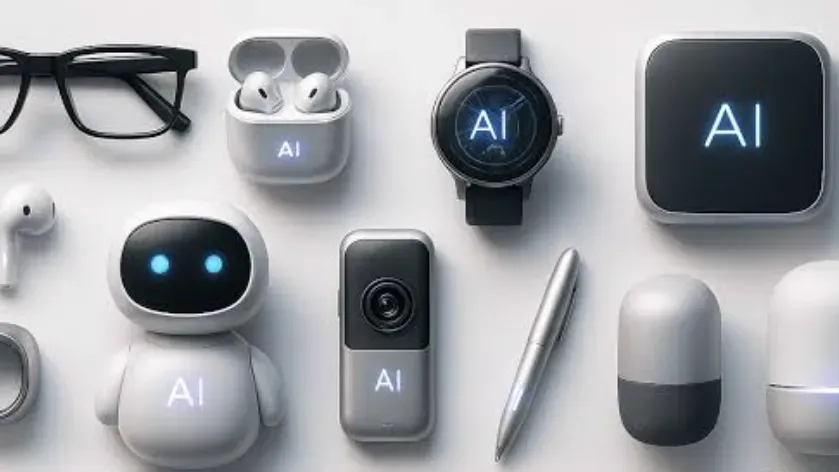
AI gadgets are made by four groups: consumer brands like Plaud and eufy, the AI models that run them, the chip-makers like Qualcomm, and the Big Tech giants who own most of it. But the brand on the box is the easiest layer to swap, and that single fact explains why so many of the startups that defined this category in 2024 have already been bought or shut down. One of them was quietly killed just weeks after we last recommended it.
The Four Layers of the AI Gadget Industry
Every smart device is a bundle from four layers. The consumer brand is the name on the box. The AI model is the brain, often OpenAI's GPT, Google's Gemini or Anthropic's Claude, or a proprietary model. The silicon is the chip, usually from Qualcomm, Apple or NVIDIA.
A Ray-Ban Meta is designed by Meta, powered by its Llama models plus Qualcomm silicon, and assembled in Asia. Knowing this layering is the key to understanding who makes AI devices at all.
Who Makes AI Wearables and Pins?
Plaud (Plaud.ai) is the most successful independent AI hardware startup so far, with more than 1.5 million users and a lineup of pin and card recorders. It launched the NotePin S in January 2026 at $179.
Limitless made the AI pendant, but Meta acquired it in December 2025 and Limitless stopped selling the Pendant on December 5, 2025, with support winding down through 2026.
Bee Computer makes the $49 Bee Pioneer wristband. Amazon announced its acquisition in July 2025, and the device still ships, sold direct rather than on Amazon.
Humane made the AI Pin, which drew brutal reviews. HP bought the remains for $116 million in February 2025 and remotely bricked every Pin that same month. Rabbit survived a rough R1 launch, and Even Realities makes prescription smart glasses, now on its G2.
Who Makes AI Smart Glasses?
Meta leads the market by a wide margin. With EssilorLuxottica it sold more than 7 million Ray-Ban and Oakley Meta glasses in 2025, roughly triple the two prior years combined, and the partners are discussing doubling output toward 20 million units.
Google is the platform, not the brand. It builds Android XR, the operating system partners use to make hardware. Samsung is the flagship partner, and it revealed its first Android XR glasses at Unpacked on July 22, 2026 for a fall launch. XREAL leads independent media glasses, while Apple trails badly, with its N50 glasses slipping to late 2027.
Who Makes AI Home and Security Devices?
Amazon dominates mass-market cameras and doorbells through Ring and Blink. Google's Nest wins on detection quality with Gemini-powered recognition. Anker's eufy owns the subscription-free camera category, and TP-Link's Tapo is the budget champion with 4K cameras under $60. See Tapo on Amazon
Which Chip Companies Power AI Gadgets?
Qualcomm's Snapdragon AR1 is the heart of almost every lightweight smart glass, from Ray-Ban Meta to Samsung's Galaxy Glasses. Apple designs its own Neural Engine in-house, Google's Tensor powers Pixel phones, and MediaTek keeps budget Android devices affordable. Buy almost any AI gadget in 2026 and you are buying a chip from one of roughly six companies, fabricated by TSMC in Taiwan.
How Big Tech Quietly Owns Everything
The acquisition pattern tells one story: Big Tech is absorbing the startup ecosystem whole.
Startup | Acquired by | Date | Product fate |
|---|---|---|---|
Humane | HP | Feb 2025 | AI Pin bricked and discontinued |
Bee Computer | Amazon | Jul 2025 | Still shipping, sold direct |
Limitless | Meta | Dec 2025 | Pendant sales ended |
Nest | 2014 | Core Google Home brand | |
Ring | Amazon | 2018 | Amazon's doorbell flagship |
Hardware is hard, and venture capital will not fund first-generation consumer devices forever, especially after Humane showed the downside. Once a startup proves a form factor works, Big Tech absorbs it.
Conclusion
The industry looks like a crowd of brands, but underneath it is a short list of chip-makers, model providers and Big Tech buyers. The safest purchases come from companies that control more than one layer, like Apple, Google, Samsung and Meta, or from independents with a real track record like Plaud and Anker. The riskiest are single-product startups that depend on a cloud service they may not fund next year.
Frequently Asked Questions
Q1: Who is the biggest AI gadget company?
A: By revenue and install base it is close between Amazon and Google. Meta leads specifically in AI wearables after selling more than 7 million Ray-Ban and Oakley glasses in 2025.
Q2: Are most AI gadgets made in China?
A: Final assembly almost always happens in China or Southeast Asia. Plaud, Anker, TP-Link and Reolink are Shenzhen companies. The chips are usually designed in the US or Taiwan and built by TSMC in Taiwan.
Q3: Which AI gadget companies went out of business?
A: Humane's AI Pin was discontinued in February 2025, and Limitless stopped selling its Pendant after Meta acquired it in December 2025. Several smaller crowdfunded pendant startups folded too.
Q4: Who makes the AI chip inside my device?
A: Most likely Qualcomm for Android phones and smart glasses, Apple for iPhones and Macs, or MediaTek for budget Android devices.
Sources include CNBC, Bloomberg and official company announcements. Reflects the industry as of August 2026.