
Updated June 2026 · 10-minute read
The AI assistants of five years ago were text-in, text-out systems. You typed a question, they generated a text response. That worked well for a narrow range of tasks, but it created a fundamental limitation: most of the real world is not text. The world is images, sounds, physical objects, movement, and context. An AI that can only read text is like an assistant who works blindfolded and wears earplugs.
Multimodal AI removes those constraints. A multimodal AI model can process multiple types of input simultaneously, text, images, audio, and video, and understand the relationships between them. This shift is what makes 2026 AI gadgets meaningfully more useful than anything that existed three years ago.
What Multimodal Actually Means
The word "modal" refers to a mode of input or a type of information. Text is one modality. Images are another. Audio is another. Video combines visual and audio information. Touch or physical sensor data can be a modality too.
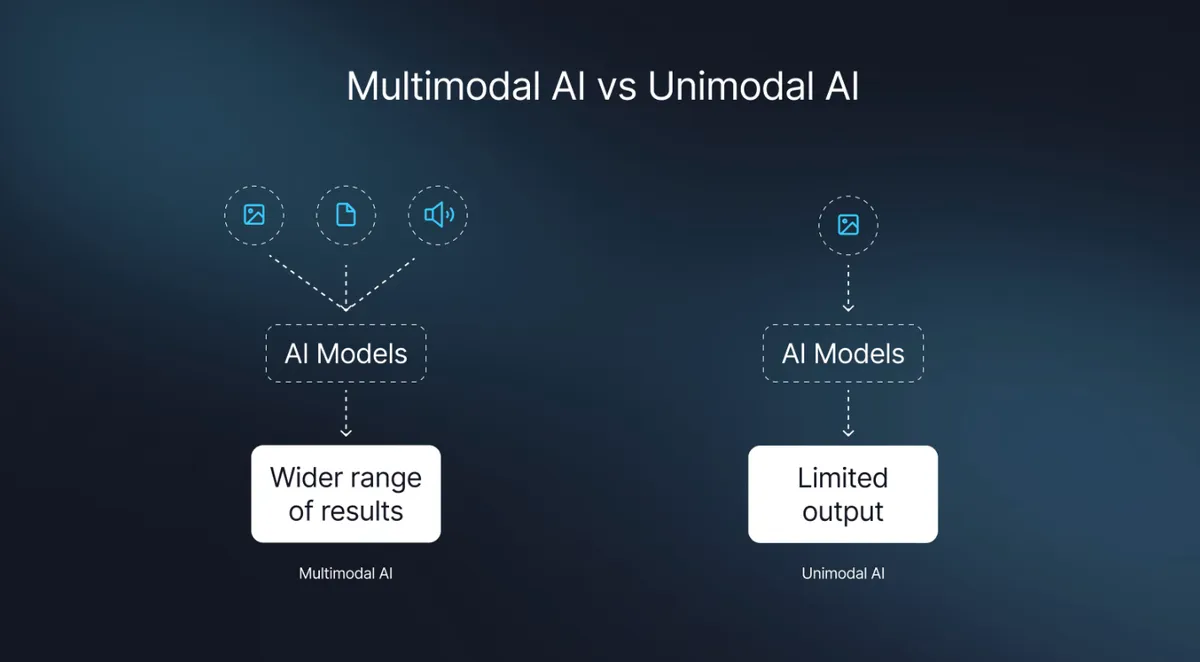
A unimodal AI works with only one of these. Early language models were purely text-based. Early image recognition models worked only with images. Each was good at its specific task but could not connect information across different types of input.
A multimodal AI model is trained on multiple types of data simultaneously and learns to understand the relationships between them. It can look at an image and describe it in text. It can hear a recording and transcribe it. It can receive both an image and a text question about that image and answer based on what it sees. It can watch a video and explain what is happening across both the visual and audio tracks.
The critical word in that description is "simultaneously." Earlier approaches to combining modalities involved separate models that were bolted together. A text model and an image model would each do their work and the outputs would be combined. Truly multimodal models process all the input types together in a single unified architecture, which allows much richer understanding of how different types of information relate to each other.
Why This Matters for Consumer Gadgets
The practical implications of multimodal AI become clear when you look at what modern AI gadgets actually do compared to earlier generations.
Consider a smart glasses device from 2021 versus Ray-Ban Meta in 2026. Both could take photos. The 2021 device stored photos. The 2026 device can look through the camera at a restaurant menu written in French, recognise it is a menu, read the text, translate it to English, and explain what dishes are available, all from a single voice command while you are standing in the restaurant. That capability requires multimodal AI: the model must simultaneously process the visual image, recognise text within it, understand the spatial layout of a menu, translate the text, and generate a spoken response.
Or consider a robot vacuum. A basic robot vacuum detects obstacles through proximity sensors. An AI robot vacuum uses a camera and a multimodal model to identify what is in front of it: a cable, a shoe, a child's toy, or pet waste, and adjusts its behaviour based on what it recognises. The visual input and the decision-making cannot be separated into independent systems if the response needs to be nuanced.
The Main Modalities in Consumer AI Gadgets
Text and language
Language remains the primary interface for most AI interactions. Voice commands are converted to text before processing in most systems. The language understanding capability in modern AI models is where the most dramatic improvements have happened in recent years, and it forms the foundation that other modalities are built on top of.
Vision: still images
Image understanding allows AI to analyse, describe, and reason about photographs. This powers the Clean Up tool in iPhone Photos, the Generative Edit features in Samsung Gallery, the Visual Intelligence in iPhone 17 Pro, and the object recognition in robot vacuums. Image models can identify objects, read text in images, understand scenes, detect emotions in faces, and classify visual content.
Vision: video
Video understanding adds the temporal dimension to image analysis. The model must understand not just what is in individual frames but how things change over time and what those changes mean. Circle to Search on Samsung Galaxy phones extends to video: you can search for an object you notice while watching a video, and the system identifies it in the relevant frame. AI dashcams use video understanding to detect driver drowsiness by tracking eye movement patterns over time.
Audio and speech
Audio modalities include speech recognition (converting spoken words to text), speaker identification (recognising who is speaking), environmental sound recognition (identifying sounds that are not speech), and music understanding. The Plaud NotePin uses speech recognition and speaker diarisation to produce attributed transcripts. Sony WH-1000XM6 uses audio processing models to identify and separate speech from background noise in real time.
Sensor data
Health wearables process a different kind of multimodal input. The Oura Ring simultaneously reads heart rate, heart rate variability, skin temperature, blood oxygen, and accelerometer movement data. Its AI models combine all these signals together to produce a Readiness Score. No single sensor in isolation gives meaningful health insight. The power comes from the AI model that understands how the different signals interact and what patterns across all of them indicate.
Multimodal AI in Smart Glasses: The Clearest Example
Smart glasses are where multimodal AI is most visible in consumer products because the combination of modalities is the entire point of the device.
Ray-Ban Meta combines vision input from the 12-megapixel camera, audio input from the four microphones, and the context you provide through voice commands. When you ask "what is this plant?" while looking at a garden, the AI processes the visual information from the camera at the same moment it processes your spoken question and generates a spoken response you hear through the open-ear speakers. All three modalities are active simultaneously.
The iPhone 17 Pro's Visual Intelligence feature works the same way. Point the camera at something, ask a question through Siri, and the AI processes what the camera sees alongside what you asked and generates an integrated answer. The system understands that "what is this?" refers to the object currently in the camera frame, not something abstract.
XREAL One's X1 chip handles spatial AI that is effectively a combination of visual input from display content and motion sensor data from the inertial measurement unit, combined to keep a virtual display locked in space as you move your head. The model must understand both what is being displayed and how the head is moving, and produce display corrections that compensate for the movement in under three milliseconds.
What Multimodal AI Cannot Do Yet
Understanding the current limits is as useful as understanding the capabilities.
Touch and haptic feedback as an AI input modality is still largely unrealised in consumer devices. Researchers are working on AI systems that can process tactile sensor data, which would be transformative for robotics and accessibility technology. In consumer gadgets in 2026, touch is primarily used as a control input rather than as data an AI model analyses.
Long video understanding at consumer scale remains challenging. Processing a two-hour film to answer questions about its plot or identify specific moments is computationally intensive and not well-served by on-device AI yet. The multimodal video features in consumer products today work well on short clips and individual frames but are limited with long-form content.
True real-time cross-modal generation, for instance generating a video soundtrack that matches the emotional content of a video in real time, is still primarily a research capability rather than a consumer product feature in 2026.
Multimodal AI Features Available Right Now by Device
Device | Modalities Used | Example Feature |
|---|---|---|
iPhone 17 Pro | Vision + Language + Audio | Visual Intelligence: identify anything you look at |
Ray-Ban Meta | Vision + Audio + Language | Identify objects, translate text, answer questions |
Samsung Galaxy S26 | Vision + Language + Audio | Circle to Search, Live Translate |
Oura Ring 4 | Multiple sensors combined | Readiness Score from HRV, temp, movement |
Roborock Qrevo Curv 2 | Vision + spatial mapping | Obstacle identification and avoidance |
Sony WH-1000XM6 | Audio + motion sensors | Adaptive Sound Control adjusts to activity |
Amazon Echo Show 8 | Vision + Audio + Language | Video calls with auto-framing, Alexa+ queries |
Frequently Asked Questions
Is GPT-4o a multimodal AI?
Yes. GPT-4o, the model from OpenAI that powers ChatGPT and integrates with Siri through Apple Intelligence, is a multimodal model. It can process text, images, and audio as inputs and generate text and audio as outputs. The "o" in GPT-4o stands for "omni," reflecting its multimodal capability. When you share a photo with ChatGPT and ask a question about it, you are using multimodal AI.
Do multimodal AI gadgets use more battery?
Processing multiple input modalities simultaneously is more computationally intensive than processing a single modality, and that does use more power. Device manufacturers manage this through dedicated NPU hardware that handles AI inference efficiently, and by using multimodal processing selectively rather than continuously. Features like real-time visual processing are activated by user action rather than running constantly.
What is the difference between multimodal AI and computer vision?
Computer vision is a specific field focused on enabling machines to interpret visual information. It is one component that can be part of a multimodal AI system. Multimodal AI is the broader concept of combining multiple types of input, which may include computer vision alongside language, audio, and other modalities. All multimodal AI systems that process images use computer vision techniques, but not all computer vision systems are multimodal.
Which AI assistant is the most multimodal in 2026?
Google Gemini was designed as a multimodal model from the ground up and handles text, images, audio, and video with strong performance across all modalities. GPT-4o is comparable in its multimodal range. Apple Intelligence is strong at combining visual and language processing on-device. In terms of consumer gadget integration, Google's combination of Gemini across Pixel phones and Nest devices offers wide multimodal capability across a connected ecosystem.
This article covers the state of multimodal AI in consumer gadgets as of June 2026. The field continues to develop rapidly, with new capabilities reaching consumer products through regular software updates.