What Is Edge AI? Why Your Next Gadget Won't Need WiFi (2026)
Updated June 2026 · 10-minute read
There is a quiet revolution happening inside the gadgets on your wrist, in your home, and in your pocket. For most of the past decade, AI features in consumer products required a continuous internet connection. The intelligence lived in the cloud. Your device was just a window into it. That model is changing, and the concept behind the change is called Edge AI.
Understanding Edge AI helps explain why devices are getting smarter without getting larger or more power-hungry, why privacy in AI gadgets is improving, and why some of the most impressive AI features in 2026 work even when you have no signal. This article explains what Edge AI is, how it works, and where you are already using it without necessarily knowing.
The Problem Edge AI Solves
To understand Edge AI, you need to understand what came before it and why that model has limitations.
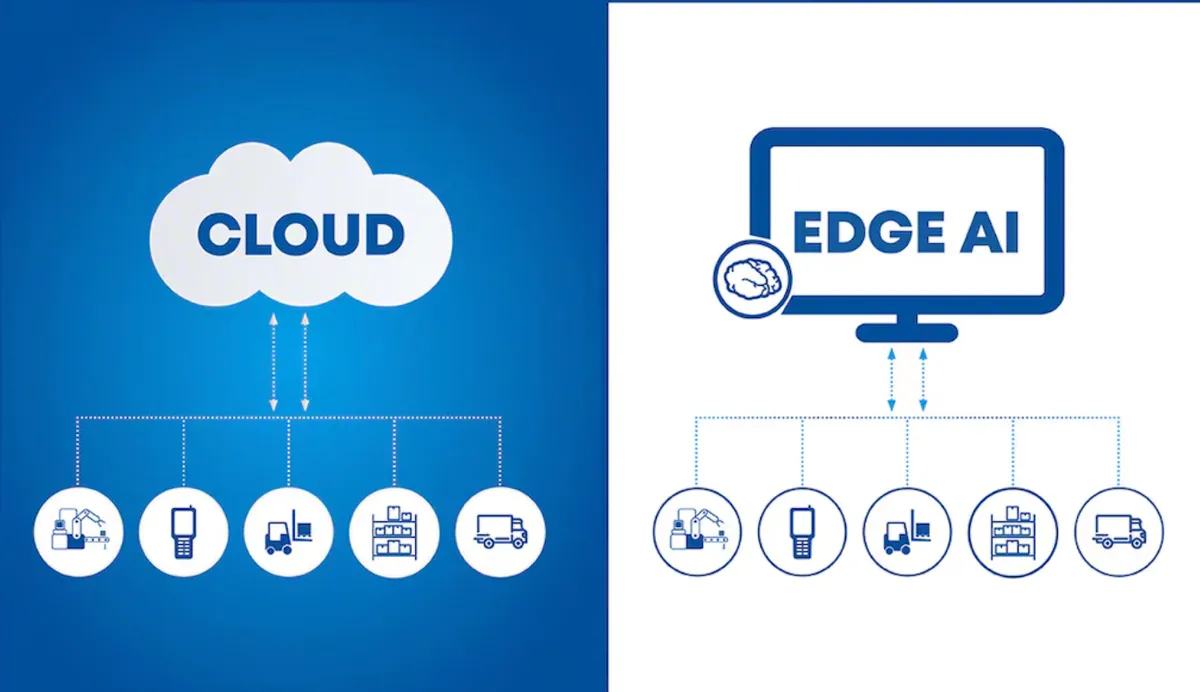
Traditional AI in consumer gadgets relied on a simple architecture: your device collected data, sent it to data centres over the internet, powerful servers ran the AI models, and the results came back to your device. This worked reasonably well when the AI tasks were simple and the latency of a cloud round-trip was acceptable.
But this model has four significant problems that become more obvious as AI features become more sophisticated.
Latency. Sending data to a server and waiting for a response takes time, typically hundreds of milliseconds even on a fast connection. For many AI applications this is fine. For others it is completely unworkable. An AI noise cancellation system in headphones must process audio and generate a cancellation signal in under a millisecond. No cloud architecture can achieve this.
Connectivity dependency. Cloud AI fails when the internet fails. A smart device that loses its intelligence every time the WiFi drops or you enter a tunnel is genuinely limited in its usefulness. Many of the most valuable AI applications are precisely the ones where connectivity cannot be guaranteed: medical monitoring, autonomous navigation, safety systems.
Privacy. Sending data to remote servers introduces privacy risks. The company running those servers processes your data, may log it, may use it to improve their models, and is subject to legal demands for access. For sensitive data categories like health information, location history, and private communications, this is a meaningful concern.
Bandwidth cost. As AI gadgets proliferate and each one is continuously sending data to the cloud, the bandwidth requirements become substantial. Running AI inference at the source reduces the data that needs to be transmitted.
Edge AI addresses all four problems by moving the intelligence from the data centre to the device itself.
What "Edge" Means
The "edge" in Edge AI refers to the edge of the network: the devices at the boundary between the physical world and the digital infrastructure. Your phone is at the edge. Your smart watch is at the edge. A robot vacuum navigating your home is at the edge. A security camera monitoring your front door is at the edge.
Traditionally, these devices were dumb endpoints that collected data and passed it toward the centre, where the intelligence lived. Edge AI inverts this. The intelligence moves to the endpoint. The data is processed where it is generated rather than being shipped to a central location for processing.
This is not a new concept in computing. Local processing of data is older than the internet. What is new is the capability of edge hardware. The Neural Processing Units now built into smartphones, smartwatches, earbuds, and other consumer devices are powerful enough to run AI models that would have required a dedicated server room a decade ago.
The Hardware That Makes Edge AI Possible
Edge AI in consumer gadgets is possible because of a generation of specialised AI chips that are small, efficient, and powerful enough to run sophisticated models on battery-powered devices.
Apple's Neural Engine is the most prominent example. Built into every A-series and M-series chip, it handles AI inference for Apple Intelligence features including Writing Tools, Face ID, photo processing, and various Siri capabilities. It performs tens of trillions of operations per second while consuming a fraction of the power that a general-purpose processor would use for the same calculations.
Qualcomm's AI Engine is built into Snapdragon processors used in Android phones. The Snapdragon 8 Gen 4 in the Galaxy S26 can run 7-billion parameter language models entirely on the device, something that would have been impossible in consumer hardware three years ago.
XREAL's X1 chip is a purpose-built edge AI processor designed for a single application: spatial tracking for augmented reality displays. It processes inertial sensor data and display adjustment calculations in under three milliseconds, a performance requirement that can only be met by dedicated edge hardware.
Even smaller devices have dedicated AI processing. Premium earbuds from Sony and Apple include audio-specific AI processors that run noise cancellation and spatial audio algorithms locally. Smart rings like the Oura Ring 4 include low-power processors that continuously run biometric monitoring algorithms without requiring a connection to a phone or cloud.
Edge AI in Specific Consumer Gadgets
Smartphones: the most complete edge AI platform
Modern flagship smartphones are the most capable edge AI devices available to consumers. Apple Intelligence on iPhone 17 runs Writing Tools, photo editing, image generation, and most Siri functions entirely on the device's Neural Engine. Samsung's Gemini Nano integration enables on-device voice recognition for Live Translate call features. Circle to Search uses local visual processing to identify objects on screen before querying Google's servers for search results.
Wearables: health AI at the edge
Health monitoring requires continuous AI processing and benefits enormously from edge AI. The Oura Ring 4 runs biometric monitoring algorithms around the clock on its embedded processor, collecting and analysing heart rate, temperature, and movement data locally. The Apple Watch's ECG and fall detection features use the watch's own S-series chip to process these time-critical measurements. Garmin running watches compute Training Status, Body Battery, and race predictions on the watch hardware using locally stored models.
Smart home devices: AI without WiFi dependency
Robot vacuums are an instructive example of edge AI in home devices. The Roborock Qrevo Curv 2 Flow runs obstacle detection on a local vision processor in the device. It identifies cables, shoes, pet waste, and other objects in real time as it navigates, making decisions in milliseconds. Waiting for a cloud response for each navigation decision would be impractical.
Smart security cameras increasingly use edge AI for object detection. Identifying whether motion is caused by a person, a vehicle, a pet, or a swaying tree branch happens on the camera's local processor in better systems. This reduces false alerts, works without internet, and avoids sending every motion event as a video clip to cloud servers for analysis.
Audio devices: edge AI for real-time processing
Noise cancellation in premium headphones is one of the oldest and most mature applications of edge AI. The Sony WH-1000XM6's QN3 processor analyses incoming audio and generates precise cancellation signals in microseconds. The Adaptive Sound Control feature uses motion sensor data and audio analysis to automatically adjust the noise cancellation profile for different environments, all processed locally in the headphones.
Edge AI vs On-Device AI: Is There a Difference?
These terms are often used interchangeably in consumer contexts and the distinction is not always meaningful for everyday gadget decisions. Strictly speaking, they emphasise different aspects of the same idea.
On-device AI emphasises that processing happens on the specific device you are using rather than in a remote data centre. Edge AI emphasises the position in the network topology: at the edge rather than at the centre. In consumer gadgets, both terms describe the same thing: AI inference running on hardware you own and carry, without sending data to external servers.
The distinction becomes relevant in industrial and enterprise contexts, where "edge" might mean a local server rather than a central data centre, rather than necessarily a small handheld device. For consumer gadgets, the practical meaning is the same.
What Edge AI Cannot Do
Being accurate about the limits of Edge AI matters as much as explaining its capabilities.
The largest and most capable AI models cannot run on edge devices in 2026. Models with hundreds of billions of parameters require the processing power and memory capacity of data centre hardware. When Siri routes a complex question to OpenAI via ChatGPT integration, it is acknowledging that the on-device model cannot handle that request adequately. The best consumer AI systems use edge AI for what it can do and cloud AI for what it cannot, rather than pretending one approach covers everything.
Edge AI models must be trained in the cloud before being deployed to devices. The training process for an AI model requires vast computational resources that no edge device can provide. What runs at the edge is the inference step: running a model that was trained elsewhere against new inputs. This means edge AI models improve through software updates that deploy new model versions to the device, not through the device learning from your data in real time.
Device storage limits how many and how large the AI models on a device can be. An iPhone can store several specialised AI models for different tasks. It cannot store the full range of models a cloud AI service runs across thousands of servers.
The Direction Edge AI Is Moving
The trajectory of edge AI in consumer gadgets is clearly toward more capability on smaller, more power-efficient hardware. Each generation of mobile and wearable chips provides substantially more AI processing capacity than the previous one. The 7-billion parameter models running on 2026 flagship phones would not have been feasible on 2022 hardware.
The practical result for consumers will be AI gadgets that work more reliably, preserve privacy better, respond faster, and function in more situations regardless of connectivity. Features that currently require internet access will increasingly work offline as the underlying models shrink and the hardware improves enough to run them locally.
Frequently Asked Questions
Is Edge AI the same as offline AI?
Not exactly, but in consumer gadgets the practical result is often the same. Edge AI processes data locally on the device, which means it does not require an internet connection for the AI processing itself. Features using Edge AI therefore work offline. Some Edge AI gadgets may still require an internet connection for other functions, like syncing data or updating AI models, but the core AI capabilities operate independently of connectivity.
Does Edge AI mean my gadget is learning from my data?
Generally no. Most edge AI in consumer gadgets today runs pre-trained models at inference time: applying a fixed model to your data to produce results. The model itself does not update based on your usage. When Apple or Samsung improve their AI models, they do so by training new versions in the cloud and pushing them to devices as software updates. On-device personalisation, where a model adapts to your specific patterns over time, exists for some features like keyboard predictions but is not universal.
Which consumer gadgets use the most Edge AI in 2026?
Apple devices with Apple Intelligence use edge AI most comprehensively for general consumer AI features. XREAL One's X1 chip is a notable example of purpose-built edge AI for spatial computing. Garmin watches run the majority of their health AI locally. Premium noise-cancelling headphones like Sony WH-1000XM6 run real-time audio AI entirely on embedded processors. Health rings including the Oura Ring 4 and Samsung Galaxy Ring continuously run biometric monitoring on their embedded chips.
Will Edge AI eventually replace cloud AI?
Not entirely. The two approaches serve different needs and the most capable AI systems will likely continue using cloud infrastructure for complex reasoning, access to up-to-date information, and tasks that benefit from very large models. What will change is the proportion of AI work done at the edge. Features that are currently cloud-dependent because the edge hardware is not capable enough will progressively move to on-device processing as the hardware improves. The result will be a world where more AI works offline and more data stays local, while cloud AI handles the tasks that genuinely benefit from the resources only data centres can provide.
This article covers Edge AI in consumer gadgets as of June 2026. Hardware capabilities in this area advance rapidly, and features described as requiring cloud processing may become available on-device in future device generations.