Updated June 2026 · 10-minute read
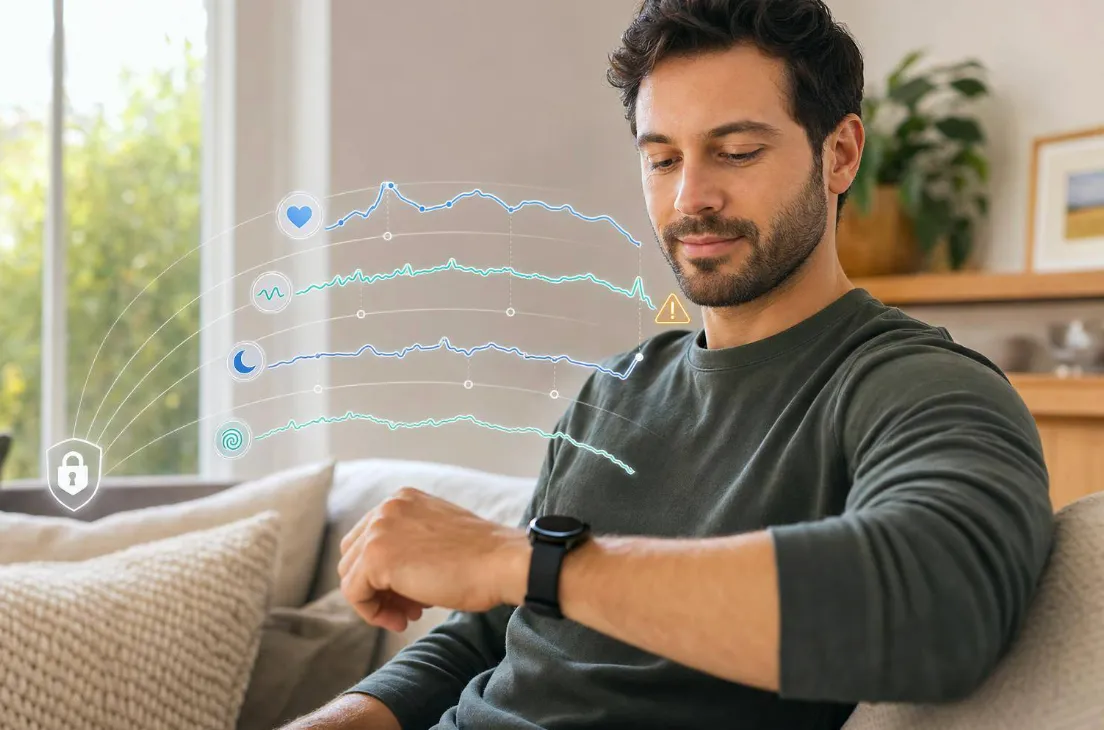
One of the most striking claims made about AI health rings is that they can detect illness before you feel sick. Oura Ring users have shared hundreds of stories about their temperature graph spiking and their readiness score collapsing a full day before they noticed any symptoms. It sounds almost like science fiction.
It is not. There is a clear, specific mechanism behind it. And it involves not just clever sensors but a set of AI anomaly detection models that compare your current physiology against your personal baseline, looking for deviations that a general wellness check would completely miss.
Why Standard Thermometers Miss Early Illness
A standard oral or forehead thermometer tells you your current temperature and compares it to the population normal of 37 degrees Celsius. A reading of 37.2 degrees comes back as normal. You feel fine. No concern raised.
The problem is that 37 degrees Celsius is a population average, not your personal normal. Some people run consistently at 36.4 degrees. Others run at 37.3 degrees. A rise from 36.4 to 37.1 is a 0.7-degree elevation that a thermometer would still call normal, but relative to that person's baseline it is a significant deviation that often precedes obvious fever by 12 to 36 hours.
This is the gap that AI wearable temperature monitoring fills. Instead of comparing you to a population average, it compares you to yourself.
The Personal Baseline Model
When you first put on an Oura Ring or WHOOP, the device starts building a personal baseline model. For temperature, this means collecting nightly skin temperature readings and computing a rolling average that accounts for your individual normal and its natural day-to-day variation.
After approximately two weeks of data, the baseline is stable enough to be meaningful. The model knows not just your average temperature but the distribution around that average: how much it typically varies from night to night, what your normal low point is in the early hours of the morning, and how your temperature pattern across the night usually looks.
From this point forward, every night's temperature reading is compared against this personal model. A deviation that falls outside your normal range, specifically a sustained elevation rather than a single spike, triggers the anomaly detection.
What the AI Is Actually Detecting
When your immune system detects a pathogen, it triggers the release of cytokines, signalling proteins that coordinate the immune response. One of the earliest effects of cytokine release is a shift in the body's temperature set point: the hypothalamus is instructed to raise the body's target temperature. This is the beginning of fever.
This shift in temperature set point happens before you feel the subjective symptoms of illness: before the sore throat, the fatigue, the headache. The body is already warming up to fight the infection. It is just warming up gradually enough that you do not notice it consciously.
Your skin temperature sensor notices. A rise of 0.5 to 1.5 degrees above your personal baseline in the overnight reading corresponds to this early immune activation. The AI model flags it as a deviation from normal before your brain registers any subjective signal of illness.
The temperature signal is one part of the picture. The AI combines it with two other simultaneously deviating metrics that together make the illness detection signal much more reliable.
The Three-Signal Anomaly Pattern
A single elevated temperature reading could be from sleeping in a warm room, from exercise earlier that day, or from a menstrual cycle phase. By itself it is ambiguous. What makes the illness detection signal robust is that three metrics deviate simultaneously, and this combination has very few alternative explanations:
Elevated skin temperature. The immune response raising the body's temperature set point. Detectable 12 to 36 hours before obvious fever symptoms in many cases.
Suppressed HRV. The autonomic nervous system shifts toward sympathetic dominance when the body is fighting an infection. This reduces heart rate variability measurably, even before you feel ill. The magnitude of HRV suppression often correlates with the severity of the infection that follows.
Elevated resting heart rate. The heart rate increase of even 2 to 5 beats per minute above your personal baseline reflects the increased cardiac output needed to support the immune response and early temperature elevation. Each degree of temperature rise requires roughly 10 additional heartbeats per minute to maintain adequate circulation.
All three signals appearing simultaneously overnight, when the only thing happening is sleep, produces a pattern that the AI's anomaly detection model flags with high confidence. The combination is essentially unique to immune activation and a small number of other physiological states, which is why the false positive rate is low enough to be useful.
The Machine Learning Behind Anomaly Detection
Oura and WHOOP both use variations of statistical anomaly detection for this purpose. The core idea is simpler than the term suggests: fit a model of what your normal data looks like, and flag nights where the observed data is unlikely under that normal model.
A baseline model might represent your temperature as a Gaussian distribution with your personal mean and standard deviation. A reading that falls 2 standard deviations above your mean has only a 2.3 percent chance of occurring by chance under normal conditions. When this simultaneously happens for temperature, HRV, and resting heart rate, the joint probability of all three being chance variation becomes very small, and the model assigns high anomaly confidence.
More sophisticated implementations use multivariate models that capture the correlations between metrics. Temperature and HRV are normally negatively correlated: slightly higher temperature nights are associated with slightly lower HRV nights within a person's normal range. An illness night shows both deviating in the expected direction but by a much larger amount than the normal correlation explains. The multivariate model captures this pattern more precisely than looking at each metric independently.
How Accurate Is It?
Independent studies and Oura's own published research show that the illness detection signal is meaningful but not perfect. Key findings from research using Oura data during the COVID-19 pandemic, where researchers had confirmed illness onset data to validate against:
In studies with NBA and NHL players during the 2020 bubble seasons, Oura data showed anomaly signals in the days before confirmed COVID-19 tests in 75 to 80 percent of cases
False positive rates (anomaly signals without subsequent confirmed illness) varied between studies but were typically in the range of 10 to 20 percent over longer monitoring periods
The signal was strongest 1 to 2 days before symptom onset, providing the most actionable advance warning window
These numbers mean the system misses 20 to 25 percent of illnesses and occasionally raises false alarms. It is not a diagnostic tool. But the ability to flag probable illness the day before symptoms appear, even imperfectly, has genuine practical value: you can reduce contact with vulnerable people, deprioritise intense training, and pay closer attention to how you feel.
Why This Only Works With Personalised AI
This is the key point that makes AI health wearables fundamentally different from previous-generation fitness trackers. A tracker that simply measures your temperature and compares it to 37 degrees Celsius cannot do this. A population-average threshold misses the individual variation that makes early detection possible.
The personalised baseline model is what makes the detection signal meaningful. It is only possible because the AI has weeks or months of your personal data to build a model of what normal looks like for you specifically. The longer you wear the ring, the better calibrated your personal baseline becomes, and the more sensitive the anomaly detection gets.
This is also why these features are only available in wearables designed for continuous wear, not in devices you use occasionally. Intermittent use produces an incomplete baseline that makes anomaly detection less reliable.
Frequently Asked Questions
Can AI wearables detect COVID-19 specifically?
No. AI wearables detect the physiological signature of immune activation, which is a general response to many infections, not a response specific to any particular pathogen. The same three-signal anomaly pattern (elevated temperature, suppressed HRV, elevated resting heart rate) appears with influenza, COVID-19, bacterial infections, and other illnesses. The wearable cannot tell you what is causing the immune activation, only that it is occurring. This is why the appropriate response to an anomaly signal is monitoring your symptoms and potentially getting tested, not assuming a specific diagnosis.
How long does it take for the AI baseline to be reliable?
Most wearable manufacturers recommend a minimum of two weeks before the baseline is stable enough for reliable anomaly detection. Oura specifically recommends waiting until the app shows a stable temperature baseline graph before relying on temperature deviation alerts. The HRV baseline stabilises faster for some users and more slowly for others depending on the natural day-to-day variability in their physiology. Three to four weeks of data generally produces a well-calibrated baseline for most users.
Does exercise or alcohol trigger false illness alerts?
Both alcohol and hard exercise can produce single-night anomaly signals similar to early illness: elevated temperature from metabolic heat, suppressed HRV from sympathetic activation, and elevated resting heart rate from the metabolic load. The practical way to distinguish these from genuine illness signals is context: you know whether you drank or trained hard the previous day. A suspicious anomaly signal with no obvious lifestyle explanation, especially if it persists for more than one night, is more likely to indicate genuine immune activation.
Does WHOOP have the same illness detection capability as Oura?
WHOOP detects similar physiological deviations through its Recovery score, which drops significantly during immune activation for the same reasons Oura's Readiness Score drops. WHOOP published research during the COVID-19 pandemic showing that their algorithm detected likely illness in users with confirmed COVID-19 an average of 2 days before positive test results. The underlying signal is the same: HRV suppression and resting heart rate elevation detected through continuous overnight monitoring against a personalised baseline.
Sources include published research from Scripps Research Digital Medicine, NBA health and safety protocol research, and peer-reviewed publications in npj Digital Medicine and JMIR mHealth and uHealth as of June 2026.