Updated June 2026 · 11-minute read
Active noise cancellation has been in consumer headphones since the 1980s, when Bose first commercialised the technology for airline pilots. The physics underlying it have not changed. What has changed dramatically over the past decade is the intelligence applied to those physics. Modern AI noise cancellation like the system in Sony WH-1000XM6 is not doing the same thing as a 1990s Bose headset. It is a different architecture, using embedded neural networks that adapt in real time to what they are hearing.
This article explains how noise cancellation works at the physics level, how DSP (digital signal processing) implements it in hardware, how AI has changed the approach, what the practical differences are between "AI" and "non-AI" noise cancellation, and what is running inside the chips in your headphones right now.
The Physics: Destructive Interference
Sound is a pressure wave. It travels through air as alternating regions of compression and rarefaction. What the eardrum detects is the variation in pressure over time, which the brain interprets as sound.
Destructive interference is what happens when two sound waves of equal amplitude are perfectly out of phase with each other: where one wave has a peak, the other has a trough of equal magnitude. The two waves cancel each other, and the result is silence. This is the physical principle that noise cancellation exploits.
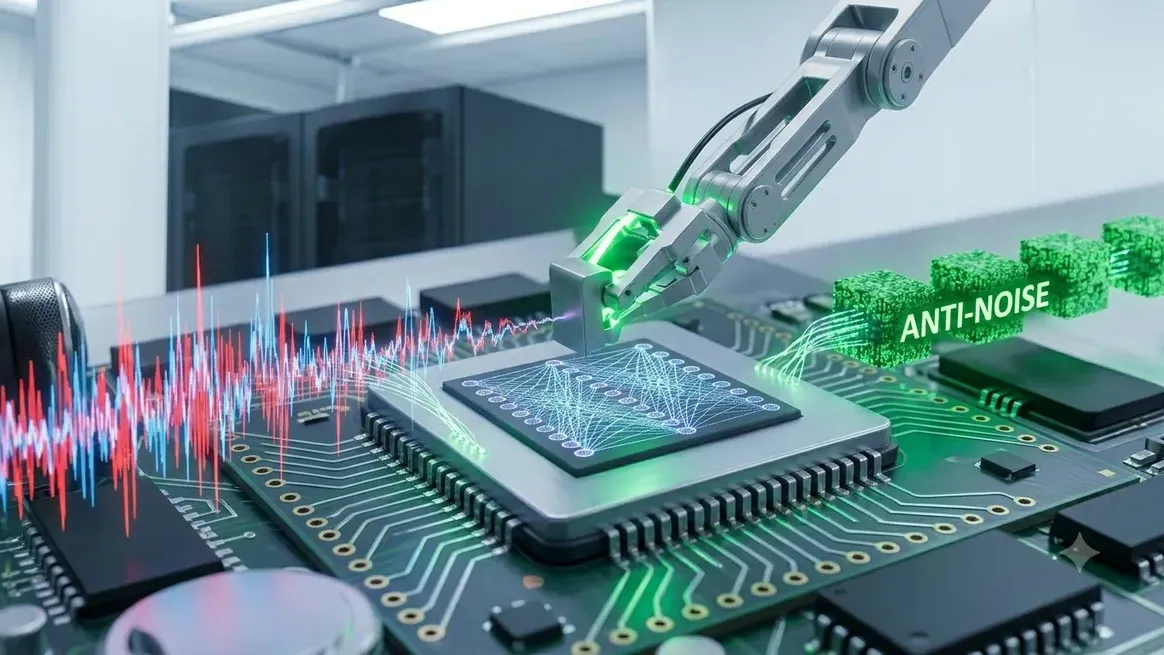
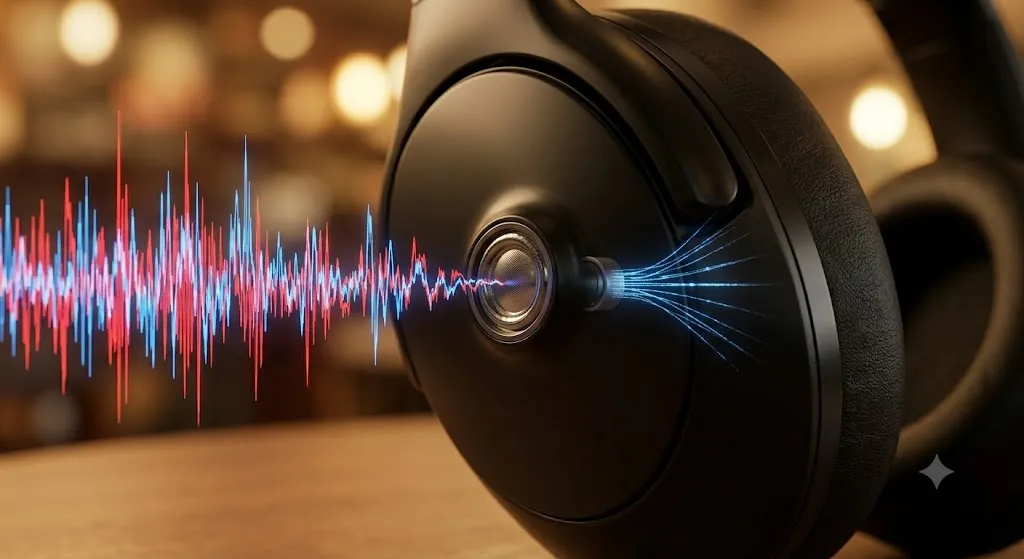
Active noise cancellation generates a sound wave that is a phase-inverted copy of the noise it wants to cancel. The anti-noise signal, when combined with the original noise wave at the eardrum, produces near-cancellation. The result is that you hear substantially less of the original noise.
The word "active" distinguishes this from passive noise isolation, which simply uses physical material (dense ear cup foam, ear tip silicone) to block sound from reaching the ear mechanically. Passive isolation works better at high frequencies where wavelengths are short enough that physical barriers are effective. Active cancellation works better at low frequencies where wavelengths are long and passive barriers are less effective. Premium headphones use both: passive isolation for mid and high frequencies, active cancellation for the low frequencies that passive material cannot effectively block.
The DSP Implementation: Feedforward, Feedback, and Hybrid
Three architectural approaches to active noise cancellation have been used in consumer products, and understanding them explains much of the difference in performance between different headphones.
Feedforward ANC
In feedforward ANC, a microphone on the outside of the ear cup picks up ambient noise before it reaches the ear. A DSP chip processes this signal, inverts its phase, and plays the anti-noise through the driver into the ear cup, all within a time window short enough that the anti-noise and the original noise arrive at the eardrum simultaneously and cancel.
The timing requirement is strict. Sound travels at approximately 343 metres per second, and the distance from the outer microphone to the driver to the eardrum is a few centimetres. The processing and reproduction must happen in under a fraction of a millisecond. This requires dedicated hardware rather than a general-purpose processor: the DSP chip in a feedforward ANC headphone is doing this calculation thousands of times per second with sub-millisecond end-to-end latency.
Feedforward ANC performs well for predictable, steady-state noise like aircraft cabin roar or train noise. It struggles with sudden changes in noise character because the processing pipeline introduces a small but non-zero delay: by the time a sudden sound is detected and cancelled, some of it has already passed.
Feedback ANC
In feedback ANC, the microphone is placed inside the ear cup, close to the eardrum. It measures what the eardrum is actually hearing and uses this measurement to adjust the anti-noise signal to improve cancellation. This is a closed-loop control system in the control engineering sense: the output is continuously measured and the input is adjusted based on the error between the desired output (silence) and the actual output.
Feedback ANC is more effective at removing residual noise that feedforward cancellation does not fully address. The trade-off is stability: feedback control loops can oscillate if the gain is too high or the phase response of the system is not carefully managed. Designing a stable feedback ANC system requires careful acoustic engineering of the ear cup and driver to ensure the feedback path has the right phase and amplitude characteristics.
Hybrid ANC
Premium headphones including Sony WH-1000XM6 and Apple AirPods Pro use hybrid ANC, combining both feedforward and feedback microphones. The feedforward microphone handles the primary noise reduction with its predictive advantage. The feedback microphone handles the residual noise that feedforward misses and provides real-time error correction. Together they achieve substantially better noise reduction than either approach alone.
Where AI Enters the Picture
Classical ANC uses fixed or slowly-adapting digital filters to process the noise signal and generate the anti-noise. These filters are designed by acoustic engineers to optimise performance for typical headphone use scenarios and then programmed into the DSP chip as fixed coefficients. They work well for the scenarios they were designed for and less well for others.
AI noise cancellation replaces or augments these fixed filters with neural networks that can adapt their behaviour based on what they are currently hearing. The specific ways AI changes the ANC system:
Adaptive filter coefficients
Rather than using fixed filter coefficients, an AI system can adjust the filter coefficients in real time based on a learned model of what the current noise environment sounds like. Steady broadband noise from an aircraft engine calls for different filter behaviour than the irregular, spectrally complex noise of a coffee shop. An AI system that has been trained on many noise types can identify the current environment and select or blend filter coefficients optimised for it.
Noise classification
Sony's Adaptive Sound Control, which they describe as AI-powered, runs a classifier that identifies the type of sound environment from both audio characteristics and motion sensor data. Is the user sitting still in a quiet office, walking down a busy street, or on a train? The classifier determines the environment and adjusts both the ANC depth and the transparency mode behaviour based on the classification. This is a neural network running on an embedded processor inside the headphone, doing inference every few seconds.
Wind noise reduction
Wind noise is one of the hardest problems for ANC microphones because wind directly striking a microphone membrane produces low-frequency pressure turbulence that looks like loud noise to the ANC system and produces artefacts if the ANC tries to cancel it. AI systems trained specifically on wind noise patterns can distinguish wind turbulence from ambient sound and suppress the ANC response in the frequency bands where wind is detected, preventing the artefacts that classical ANC produces in windy conditions.
Voice preservation in transparency mode
Transparency or pass-through mode uses the ANC microphones to amplify ambient audio and play it into the ear alongside music, allowing the user to hear the environment without removing the headphones. Naive transparency mode amplifies everything including noise, making it unpleasant in loud environments. AI voice enhancement in transparency mode uses a neural network to separate speech from background noise in the transparency feed, amplifying speech while suppressing noise and producing a cleaner, more natural transparency experience.
The Chips Doing This Work
Inside a pair of Sony WH-1000XM6 headphones, there are two primary chips handling the audio processing.
The QN3 processor is Sony's dedicated noise cancelling chip. It handles the core feedforward and feedback ANC processing, operating with end-to-end latency under 2 milliseconds. This chip runs continuously whenever ANC is active, processing microphone input and generating anti-noise output in hardware at rates that a general-purpose processor could not achieve with acceptable battery consumption.
The V2 audio processor handles everything else: Bluetooth communication, codec processing (LDAC, AAC, SBC), equalisation, Adaptive Sound Control classification, and the higher-level AI features like Speak-to-Chat detection. This chip uses a combination of traditional DSP operations and small neural networks to implement its AI features.
The separation of functions across dedicated chips is intentional and important. Putting everything on one chip would require that chip to be fast enough for the latency-critical ANC processing while also being capable enough for the higher-level classification tasks. Dedicated chips allow each function to be implemented on hardware optimised for its specific requirements, which is more efficient in both performance and power consumption than a general chip doing everything.
Why ANC Latency Matters and How It Is Achieved
The latency requirement for ANC is among the strictest in consumer electronics. The processing from microphone input to speaker output must complete in under 2 milliseconds to be effective at the frequencies where ANC is most useful.
To understand why, consider the geometry. Sound from an external noise source travels to the outer microphone, into the ear cup, and to the eardrum. In a typical over-ear headphone, this path adds only a few millimetres of additional distance to the direct path from source to ear, corresponding to well under 0.1 milliseconds of additional travel time. The ANC processing must happen within this window or the anti-noise signal arrives after the noise it is trying to cancel, producing a different (and often worse) sound rather than cancellation.
Achieving this requires processing on hardware that has no operating system overhead, no memory management latency, and no scheduling jitter. The ANC DSP chip runs bare-metal firmware with deterministic timing, receiving samples from the ADC (analogue to digital converter) connected to the microphone, running a fixed-point computation, and outputting samples to the DAC (digital to analogue converter) connected to the driver, in a tight processing loop with hardware-guaranteed timing.
Modern ANC chips achieve this with ARM Cortex-M class processor cores running at 200-400 MHz with dedicated hardware multiply-accumulate units for the filtering operations, and DMA (Direct Memory Access) channels that transfer audio samples to and from the processor without CPU intervention.
AI vs Classical ANC: Is the AI Difference Real?
This is a question worth answering honestly because "AI" is used loosely in headphone marketing.
The core ANC processing in all headphones, including those marketed as AI-powered, is classical DSP: digital filters, phase inversion, adaptive filter algorithms like LMS (Least Mean Squares) or NLMS (Normalised LMS). These are well-established signal processing techniques that predate neural networks by decades.
What AI genuinely adds in the best current headphones:
Environment classification that adjusts ANC behaviour to match noise type
Wind noise detection that prevents ANC artefacts
Voice isolation in transparency mode that improves speech clarity
Wear detection using sensors and a classifier to auto-pause audio
Speak-to-Chat detection that pauses music when the user starts speaking
What "AI ANC" marketing often implies but does not mean: a fundamentally different approach to the core noise cancellation physics. The anti-noise generation is still classical DSP. The AI is in the intelligence layered around it.
The genuine improvement from AI is real but incremental rather than revolutionary. Headphones with AI environmental adaptation do perform noticeably better across varied environments than fixed-filter headphones. The gap is largest in transitions: moving from a quiet office to a busy street, or encountering sudden wind. The AI system adapts within a second or two; a fixed system applies the same filters regardless.
Frequently Asked Questions
Why does ANC cause a pressure sensation in your ears?
Some users experience a sensation of pressure or fullness when using ANC headphones even with no music playing. This is caused by the anti-noise signal itself. The brain perceives very low frequency pressure variations as a physical sensation rather than sound, and imperfect low-frequency ANC cancellation can produce a residual signal in this range. Some ANC systems exacerbate this by generating slight sub-bass pressure in the attempt to cancel infrasonic components. Sony and other manufacturers have added settings to reduce this effect, sometimes labelled "Atmospheric Pressure Optimiser" or similar, which adjust the ANC response at the lowest frequencies.
Does ANC work better on over-ear or in-ear headphones?
Both can achieve excellent ANC performance but through different balances of active and passive attenuation. Over-ear headphones have more physical space for microphones and larger drivers, which allows deeper ANC at low frequencies. In-ear headphones with well-sealing ear tips provide excellent passive isolation at mid and high frequencies and can achieve very effective ANC overall because the anti-noise has a very short distance to travel to the eardrum inside the sealed ear canal. Top-tier examples of both form factors achieve comparable overall noise reduction in testing.
Why does ANC not work on high-frequency sounds like voices?
ANC effectiveness drops at higher frequencies because the wavelengths become shorter. At 1000 Hz, the sound wavelength is about 34 centimetres. At 4000 Hz, it is about 8.5 centimetres. The timing precision required to achieve phase cancellation at shorter wavelengths is more demanding because a small timing error represents a larger fraction of the cycle. Most ANC systems are effective below around 1 to 2 kHz, which covers the low-frequency rumble of engines and HVAC systems but not the frequency range of conversational speech, which is why you can still hear people talking around you even with ANC enabled.
What is Speak-to-Chat and how does it detect speech?
Speak-to-Chat, a feature in Sony WH-1000XM6 and similar headphones, detects when the user starts speaking and automatically pauses playback and activates transparency mode so the user can have a conversation without removing the headphones. The detection uses a microphone and a small neural network or classifier that distinguishes the user's voice (detected primarily through bone conduction and the proximity of the sound) from external speech detected by the outer microphone. The detection typically activates within 0.5 to 1 second of the user starting to speak and deactivates several seconds after they stop.
Technical specifications referenced in this article are based on published manufacturer documentation, IEEE signal processing literature, and independent measurements from audio testing publications as of June 2026.