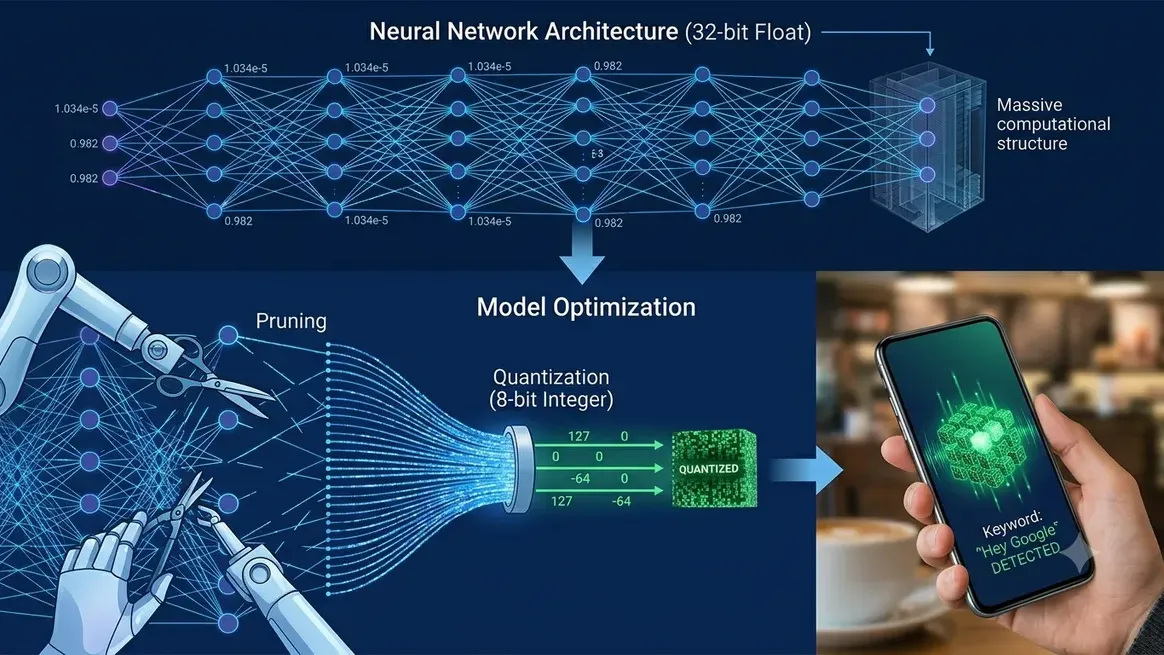
TinyML is machine learning that runs on tiny, ultra-low-power microcontrollers, chips smaller than your thumbnail, with no cloud and no big processor. It rarely makes headlines, yet it runs in hundreds of millions of devices. It needs no data center and no neural engine, just a chip with as little as 256KB of RAM, drawing less power than a small LED, often on a coin battery that lasts months or years.
It is what lets your thermostat hear its wake word offline, your tracker know you are doing push-ups, and your doorbell tell a person from a passing car without uploading every frame, a big reason modern AI gadget can be so small, cheap and private.
What Problem Does TinyML Solve?
There is an enormous gap between the hardware AI usually runs on and the hardware in most connected devices. Large AI models need hundreds of gigabytes of RAM and hundreds of watts. Even a phone's Neural Engine needs a big battery and a cooling system.
But most connected devices are not phones. They are microcontrollers: cheap chips in smoke detectors, glucose monitors, hearing aids and sensors, with maybe 256KB to 1MB of RAM and a few milliwatts of power. Until TinyML, putting AI on them was not practical, since useful neural networks were too big for kilobytes of memory. TinyML is the set of techniques that make AI inference work inside those limits.
How Does TinyML Shrink AI Models?
A trained model might have millions of parameters stored as 32-bit numbers, larger than a microcontroller's whole memory. TinyML shrinks that by orders of magnitude.
Quantization converts 32-bit numbers to 8-bit or 4-bit integers, cutting memory 4 to 8 times for usually under 1 percent accuracy loss. Pruning removes the many near-zero weights that barely affect the output, making a model 50 to 90 percent smaller. Knowledge distillation trains a small "student" to imitate a large "teacher." And efficient architectures like MobileNet are built for low compute from the start.
In practice: a full BERT language model needs about 440MB, a distilled TinyBERT about 55MB, and a quantized-and-pruned version under 5MB. A wake-word model for "Hey Alexa" can run in under 100KB.
Where Is TinyML in Gadgets You Already Own?
Wake-word detection. When your Echo or Nest listens for its wake word, a TinyML model runs on a tiny low-power chip while the main processor sleeps. Only a confident match wakes the main chip and sends audio to the cloud, so always-on listening costs milliwatts, not watts.
Activity recognition. The way a Fitbit, Garmin or Apple Watch tells walking from running is a small model reading motion sensors on the watch's low-power core, running every few seconds and sipping microwatts between.
Fall detection. Apple Watch fall detection, which has saved lives, runs a TinyML model that spots the pattern of a fall plus impact, tells it from vigorous exercise, and reacts within seconds, all day on a small battery.
Earbuds and rings. Premium headphones run always-on noise cancellation locally, and smart rings like the Oura Ring 4 and Samsung Galaxy Ring turn raw sensor data into health metrics on a battery the size of a coin.
Which Chips Are Built for TinyML?
Chip | Maker | AI feature | RAM |
|---|---|---|---|
STM32 with NeuralART | ST | Neural accelerator | Up to 1MB |
Ambiq Apollo5 | Ambiq | AI co-processor | Up to 4MB |
MAX78002 | Analog Devices | Ultra-low-power CNN | 384KB |
Syntiant NDP120 | Syntiant | Neuromorphic audio AI | On-chip |
RP2350 | Raspberry Pi | RISC-V with ML | 520KB |
Syntiant's audio chips stand out, running inference under 140 microwatts, so efficient a hearing-aid battery can power continuous wake-word detection for the device's whole life.
TinyML vs NPU vs Cloud: The Spectrum:
Level | Hardware | Power | Model size |
|---|---|---|---|
TinyML (microcontroller) | ARM Cortex-M, Syntiant | Microwatts to milliwatts | Under 1MB |
Edge AI (mobile NPU) | Apple Neural Engine, Qualcomm | Hundreds of milliwatts | Tens to hundreds of MB |
Cloud AI | Data-center GPUs | Hundreds of watts | Tens to hundreds of GB |
TinyML handles the lowest-power always-on jobs (wake words, activity, anomaly detection), NPUs handle richer tasks, and the cloud handles the largest. Many gadgets use all three: TinyML wakes the device, the NPU preprocesses, the cloud answers.
Why Does TinyML Help Your Privacy?
Here is the overlooked part. When AI runs on a microcontroller inside a sensor, the raw data never has to leave the device. Only the result, a much smaller and less sensitive thing, gets sent.
A camera with on-device TinyML person detection processes each frame locally: if no person is seen, nothing is transmitted, and if one is, only an alert goes out, not the video. The same holds for a glucose monitor that reports only the reading, or a hearing aid that processes audio without ever transmitting your conversations. That is a fundamentally more private design than sending everything to the cloud.
Conclusion:
TinyML is the smallest, most invisible layer of on-device AI, and one of the most important. It puts real intelligence on chips too tiny for anything else, which is why so much of what feels magical about modern gadgets, instant wake words, all-day health tracking, private detection, happens on a chip you will never see. As models keep shrinking, expect it in ever more of what surrounds you.
(FAQs):
Q1: What is the difference between TinyML and Edge AI?
A: TinyML is machine learning on microcontrollers with memory in kilobytes and power in microwatts. Edge AI is broader, covering TinyML plus AI on more capable devices like phones with NPUs. All TinyML is Edge AI, but not all Edge AI is TinyML.
Q2: Can TinyML run large language models?
A: Not really. LLMs need gigabytes of memory, far beyond a microcontroller. TinyML runs small models for specific jobs like wake-word spotting and simple intent detection. Microsoft's Phi small-model family runs on around 1GB of RAM, still well above microcontroller scale.
Q3: Which languages are used for TinyML?
A: C and C++ for deployment, since they give tight control over memory. Models are usually trained in Python (PyTorch or TensorFlow), then converted, quantized and compiled to C++ for the device.
Q4: How do I get started with TinyML?
A: The easiest path is an Arduino Nano 33 BLE Sense or a Raspberry Pi Pico paired with Edge Impulse, a free web platform that collects sensor data, trains a model without ML code, and generates ready-to-run code for the board.
Covers TinyML concepts and tools as of 2026. The field advances quickly, with new compression techniques and hardware released regularly.