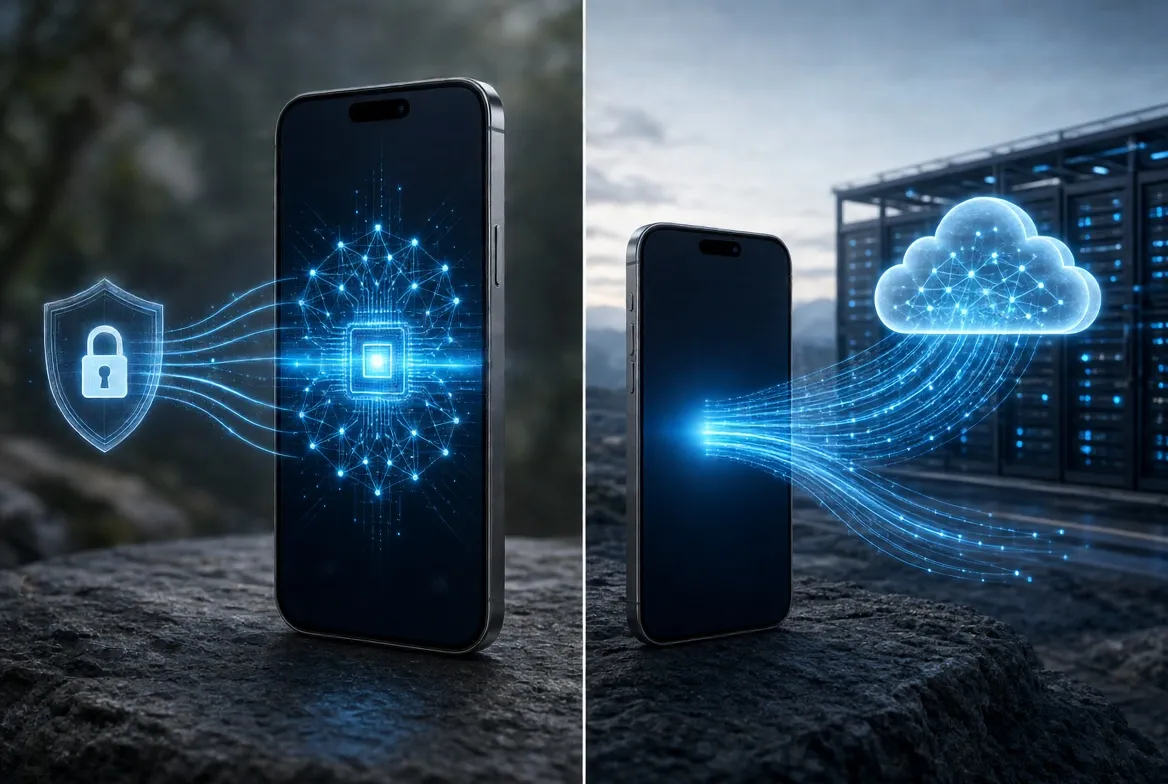
On-device AI processes your data on the gadget itself, while cloud AI sends it to remote servers to do the thinking. Most products mix both, but which one handles a given task quietly decides four things you care about: your privacy, how fast it responds, whether it works offline, and your battery life. Here is the difference, and why privacy is the part that matters most.
How Does On-Device AI Work?
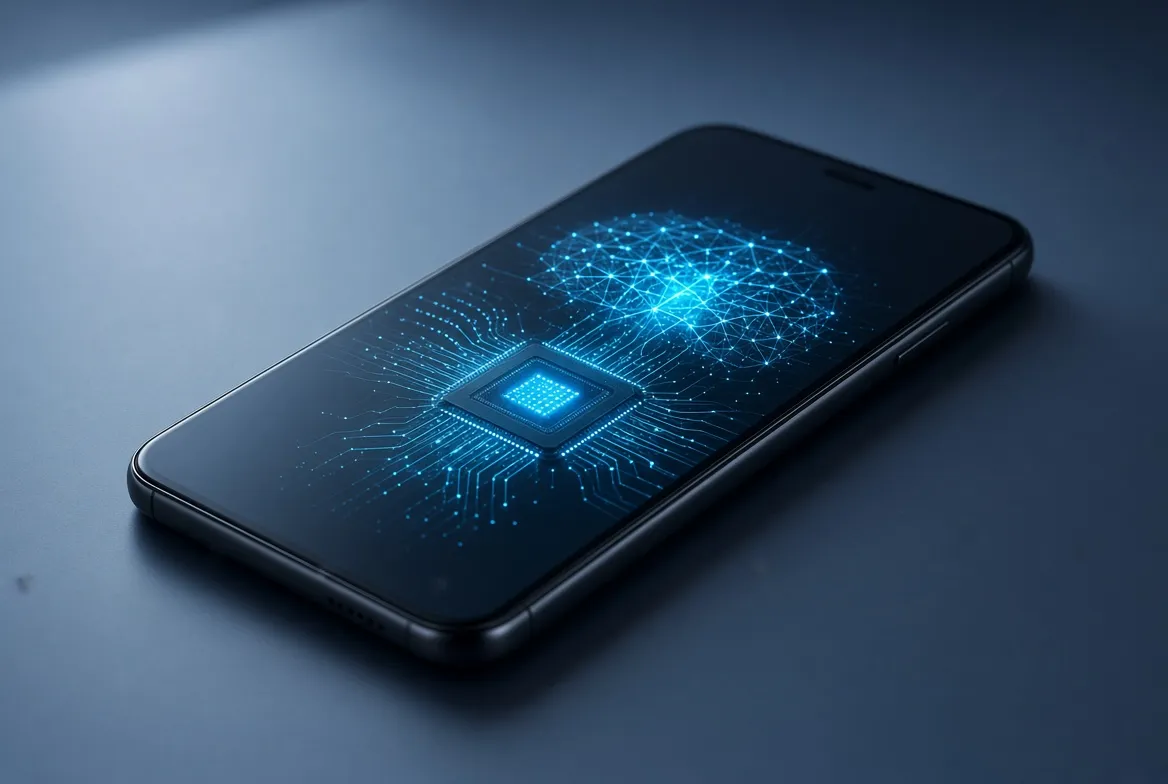
On-device AI runs the model entirely inside your gadget's chips. No data leaves the device, and no internet is needed. The work happens on a dedicated NPU (Neural Processing Unit) built to run AI efficiently without draining the battery.
When Apple Intelligence proofreads an email, the text never leaves your iPhone, and Face ID processes your face on a secure chip that never sends the data anywhere. The advantages are privacy (your data cannot be logged or accessed by anyone else), speed (no network round-trip), and offline use (it works on a plane or during an outage). The trade-off is capability: on-device models are smaller and compressed, so they cannot match the giant models in a data center.
How Does Cloud AI Work?

Cloud AI sends your request to remote servers, runs it on much larger models, and returns the result. Ask Alexa a complex question and your voice travels to Amazon's servers, a large model answers, and the reply comes back as audio.
The capability is the draw: cloud models can have hundreds of billions of parameters and reach live information the device cannot. The cost is privacy, latency and connectivity. Your data crosses the internet to a company's servers, where it may be logged and used to train future models, and if your connection drops, the feature stops working.
What Does This Mean for Your Privacy?
This is where the difference matters most. When a feature sends data to the cloud, it passes through your router, your internet provider and the public internet before reaching the company. Their privacy policy then decides what happens: whether it is logged, how long it is kept, whether it trains their models, and when it might be shared with third parties or law enforcement. With on-device AI, none of that happens, because the data never leaves your hardware.
One caution: "encrypted" does not mean "private." Encrypted data can still be processed and stored by the company holding the keys. End-to-end encryption, where only you hold the keys, is stronger. On-device processing is stronger still, because no outside party is involved at all.
Why Health Data Deserves Special Attention
The stakes are highest for health data. Heart rate, sleep staging, cycle tracking and HRV, and the AI reading of them, are among the most sensitive information that exists, and can reveal medical conditions or, in some places, affect insurance. Garmin and Apple Watch process most health AI on the watch itself, while Oura uses the cloud for its detailed insights, which is why reviewing Oura's privacy policy matters if you choose it.
How Do Real Gadgets Split the Work?
Most 2026 gadgets are hybrid. Knowing how a product splits the work is more useful than thinking in absolutes.
Feature | On-device | Cloud |
|---|---|---|
iPhone Face ID | 100% | Never |
Apple Writing Tools | 100% | Never |
Siri complex queries | Wake word | Query processing |
Alexa voice commands | Wake word only | All processing |
XREAL display tracking | 100% (X1 chip) | Never |
Garmin health metrics | Most calculations | Sync and backup |
Oura Ring AI insights | Sensor recording | Most AI analysis |
Ray-Ban Meta queries | Wake word only | All Meta AI |
When Does On-Device Speed Actually Matter?
For most conversational features, the speed difference is too small to notice. But some tasks make cloud processing impossible. AR display stabilization has to correct for head movement in a few milliseconds, so a cloud round-trip would make the image visibly lag, which is why it runs on the glasses' own chip. Noise cancellation works the same way, generating the cancelling sound wave in microseconds locally. The rule: the more time-critical the task, the more it must run on-device, whatever the privacy angle.
Apple's Private Cloud Compute: A Third Option
Apple offers a middle ground. Private Cloud Compute routes requests too complex for the device to Apple's servers, but those servers are built to process the request without storing or logging it, staff cannot access the data, and the server software is published for inspection. That differs from standard cloud AI, where data is often logged and used to improve models. Whether you trust the claims is a personal call, but it is a serious attempt at cloud-scale power without the usual privacy cost.
Conclusion
On-device AI keeps your data with you: private, fast and offline, but limited to smaller models. Cloud AI is far more capable but hands your data to someone else's servers. Most gadgets blend the two, so the smart move is knowing which does what, especially for health data. Prefer on-device processing for anything sensitive, read the data-retention section of a privacy policy before you buy, and remember that a device which never has your data is the only one a future company sale or breach cannot touch.
Frequently Asked Questions
Q1: Does on-device AI use more battery than cloud AI?
A: It depends. For light tasks, a dedicated NPU can beat network activity plus a server round-trip. For very heavy tasks that push the chip hard, local processing may use more. For most features, the impact is manageable.
Q2: Can on-device AI be as good as cloud AI?
A: For many specific tasks, yes, on-device writing tools rival cloud assistants. For general knowledge and complex reasoning, cloud AI is still more capable, but the gap is narrowing as chips and model compression improve.
Q3: What happens to my data if the AI company is sold?
A: The buyer usually inherits your data under the existing policy, which can then change. This is a strong reason to prefer on-device AI for sensitive data: no stored data means a sale cannot affect you. The Humane AI Pin sale to HP is a recent example.
Q4: Is Alexa always listening and sending audio to Amazon?
A: No. Echo devices detect the wake word locally without sending audio. Only after the wake word, when the light turns on, is audio sent to Amazon, and you can review or auto-delete those recordings.
Privacy practices here reflect publicly available information as of 2026. Always review a device's current privacy policy before purchase, as these change.