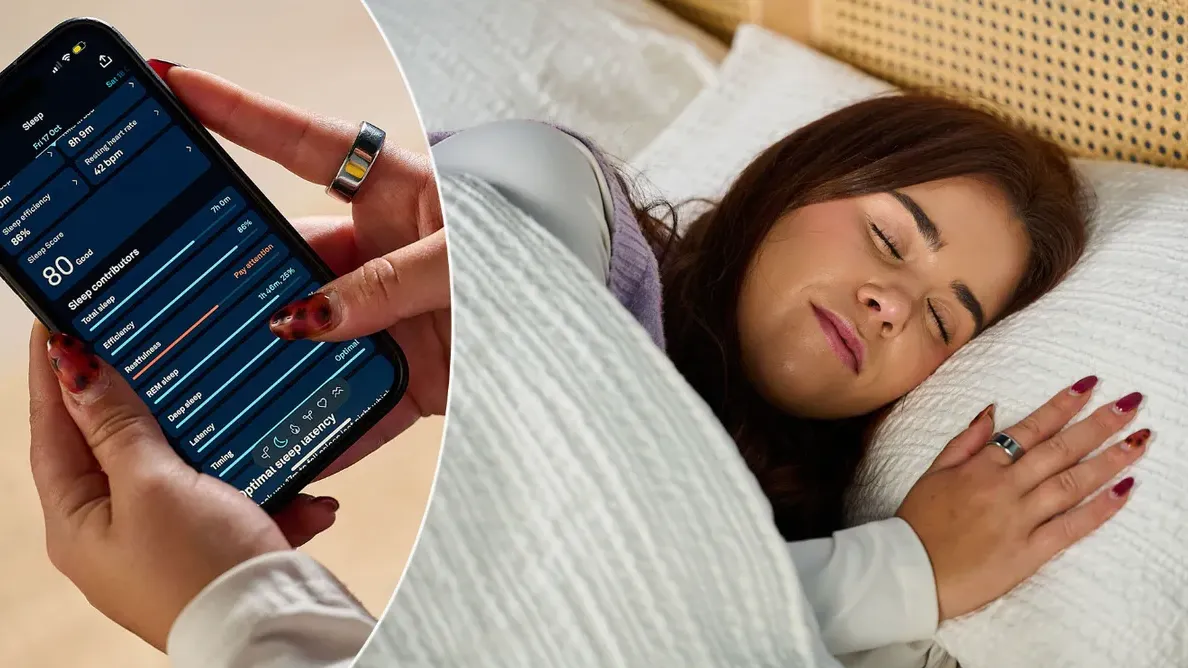
This article is for general information only. Oura Ring is a wellness tool, not a medical sleep-study device.
Every morning your Oura Ring tells you how much deep, REM and light sleep you got, and most people accept the number without a second thought. But how does a titanium band on your finger know you were in REM at 2:47am? The answer is a surprisingly clever pipeline of optical sensors, signal processing and a machine learning classifier trained against real clinical sleep studies. Here is exactly how it works.
Step 1: The Optical Sensor Collects Raw Light Data:
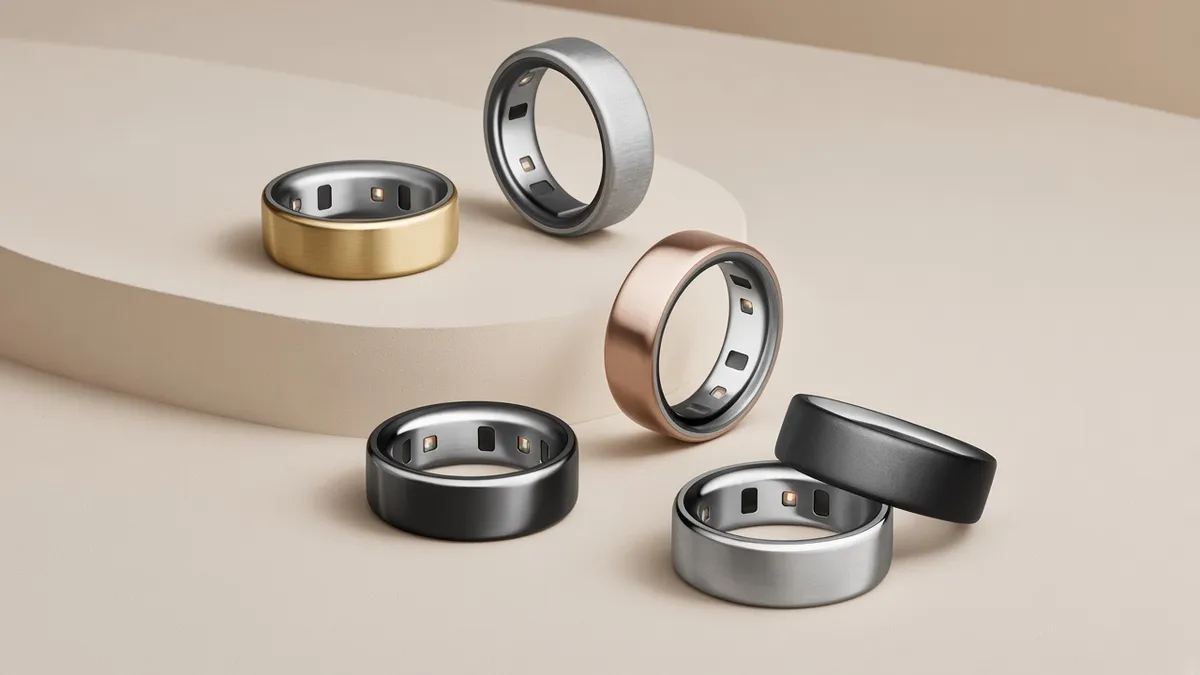
The Oura Ring 4 has LED emitters and photodetectors on the inner surface, pressed against the palm side of your finger. Through the night it pulses those LEDs every few seconds, shining light into the tissue and measuring how much bounces back.
Different wavelengths do different jobs. Green LEDs (around 530nm) are absorbed strongly by blood and give a clear pulse signal, infrared penetrates deeper for another view of blood flow, and red light is used mainly for blood-oxygen estimation.
The output is a stream of light readings with your heartbeat buried inside a much larger background signal, which has to be processed before it is useful.
Step 2: Signal Processing Extracts Heart Rate and HRV:
This raw photoplethysmography (PPG) signal is filtered to remove the slow background and leave the small pulse from each heartbeat. A peak-detection step then marks each beat and measures the inter-beat interval (IBI), the gap between beats, which produces two key numbers:
Heart rate: 60 divided by the average IBI.
HRV (RMSSD): the beat-to-beat variability in those intervals.
Both are tracked all night, and this is the insight that makes wearable sleep staging possible: different sleep stages produce measurably different cardiac patterns.
Step 3: The Accelerometer Adds Movement:
The ring also has a 3-axis accelerometer sampling motion at 50Hz, doing two things. It catches movement, tossing and restlessness, which flags wakefulness and light sleep, since stillness precedes deep sleep. And it cleans the optical signal: when your hand moves, the light sensor picks up noise, and the accelerometer tells the system which readings to distrust.
Step 4: Feature Extraction Across Time Windows:
The AI does not read raw samples. A feature-extraction layer summarizes the data across sliding windows of 30 seconds to a few minutes: average heart rate, HRV, breathing rate (from the slow sway in the PPG signal), movement, temperature versus baseline, and time of night. This compact feature vector, updated every 30 seconds, is what feeds the classifier.
Step 5: The Classifier Assigns Sleep Stages:
The classifier takes that feature vector and outputs a probability across four stages: Awake, Light (NREM 1 and 2), Deep (slow-wave), and REM. Oura does not publish its exact model, but research in this field uses two main approaches.
Random forests combine hundreds of decision trees and work well because some transitions are clear (lots of movement means awake, very low heart rate with high HRV means deep sleep). Recurrent networks (LSTMs) model sleep as a sequence, learning you cannot jump straight from awake to REM, and use the earlier night to inform the current call. Oura's filings suggest a combination: one stage classifies, another smooths the sequence so transitions stay realistic.
How the Model Was Trained:
Training needs labeled data: ring readings recorded at the same time as a clinical gold standard. That standard is polysomnography (PSG), the sleep-lab study where scalp electrodes measure brain waves (EEG) directly, which no wearable can match.
Oura has published that its training set includes thousands of nights of simultaneous ring-and-PSG recordings. The model learns which sensor patterns match which PSG-confirmed stages, then is validated on nights it never trained on. Results for the earlier Ring 3 showed around 79 to 81 percent agreement with PSG, about the same as two human experts scoring the same study, and a reasonable ceiling for a finger sensor.
Why the AI Sometimes Gets It Wrong:
Light and REM get confused. These two are the hardest pair to separate from optical data: both have higher, more variable heart rates than deep sleep, and without EEG the ring cannot see the eye movements that define REM. Every wearable, not just Oura, is weakest here.
Unusual physiology. The model was trained on a research population, so if your resting heart rate or HRV sits far outside that range, your readings map less cleanly onto the learned boundaries.
Alcohol and medications. Both change the cardiac signatures of sleep. Alcohol in particular suppresses REM later in the night and raises heart rate throughout, which can push the model off.
Conclusion:
Your Oura sleep breakdown is not a guess, it is the output of a real sensor-and-AI pipeline validated against clinical sleep studies. But it is an estimate, strongest as a trend over weeks rather than a precise verdict on any single night, and weakest at telling light sleep from REM. Understand what it measures and you will read your numbers correctly: trust the direction over time, not the exact minutes of one night.
(FAQs):
Q1: Is Oura sleep staging as accurate as a clinical sleep study?
A: No, and Oura does not claim it is. A lab study measures brain waves directly, while Oura reaches about 79 to 81 percent agreement. Use it for tracking trends, not as a precise nightly measurement.
Q2: Why does Oura sometimes show no deep sleep at all?
A: Deep sleep has the most distinct signature, very low heart rate, high HRV, stillness, so if any is borderline the model assigns light sleep instead. Alcohol, a warm room, caffeine and an odd sleep time also genuinely reduce deep sleep.
Q3: Does Oura's AI learn my personal patterns?
A: The core model is the same on every ring and is not retrained on you in real time, though Oura improves it over time with firmware updates. Your scores are personalized through your own baseline, so deviations are judged against your normal.
Q4: Why is REM harder to detect than deep sleep?
A: Deep sleep produces an obvious pattern. REM's cardiac signature overlaps heavily with light sleep, and without eye-movement or EEG sensors the ring relies on subtle differences, so it confuses the two more often.
Draws on published Oura research, peer-reviewed wearable sleep-staging studies, and signal-processing literature as of 2026.