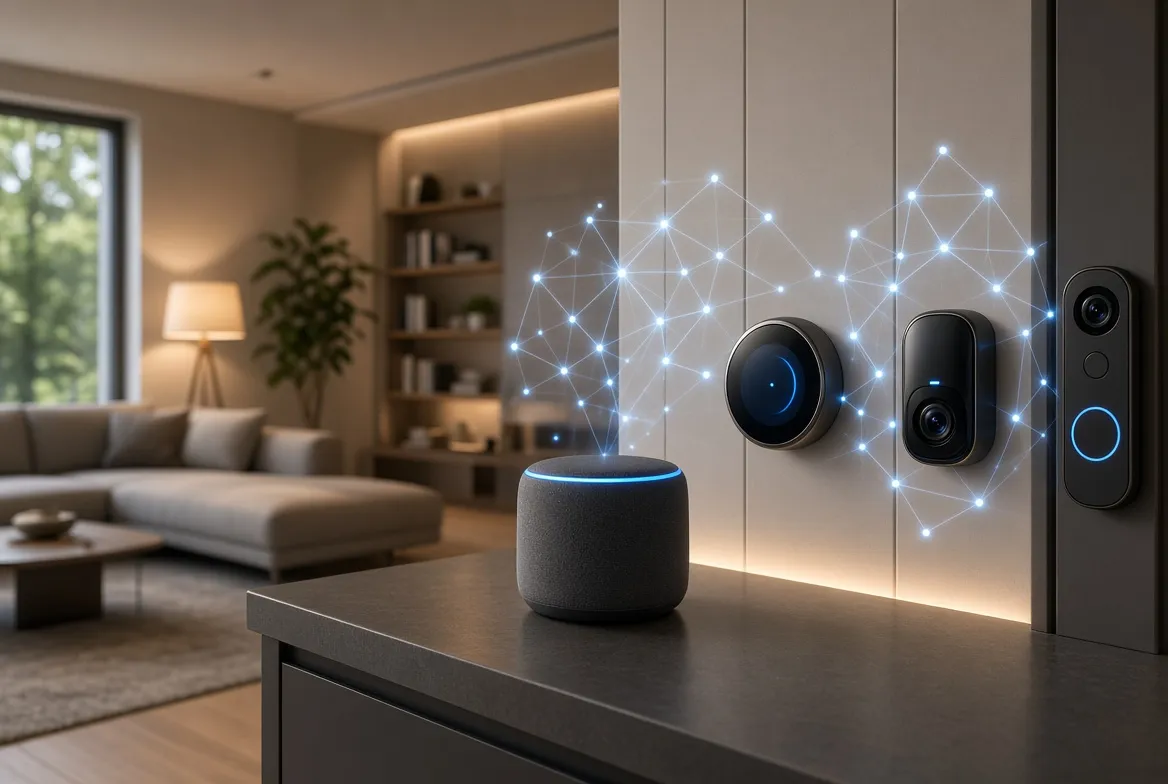
Embedded AI in smart home devices means a small neural network runs directly on the device, detecting a wake word, a person, or an empty room, while heavier tasks go to the cloud. Most of the time it is invisible: your thermostat adjusts itself, your doorbell tells a delivery driver from a stranger, your speaker wakes only for its name. Here is what is actually running inside the devices you already own.
Smart Speakers: The Two-Chip Architecture:
Echo, Nest Audio and HomePod all split the job across two chips.
A tiny, always-on low-power chip runs a wake-word model, often under 500KB, listening in windows of 10 to 30 milliseconds. Syntiant NDP chips, used in some Echo devices, do this at under 200 microwatts, one job and nothing else.
Once the wake word is confirmed, a quad-core application processor wakes up, captures your command, streams it to the cloud, and plays the response, drawing far more power but only for seconds. Echo Show devices add a camera, using a vision model to keep your face centered as you move.
Smart Thermostats: Learning and Presence:
Nest and Ecobee are called AI-powered, but the core is closer to pattern learning than deep learning.
Nest's Learning Thermostat watches your manual adjustments for a few weeks and builds a schedule from the pattern, a statistical model simple enough to run entirely on the thermostat itself.
For occupancy, most use PIR sensors that detect body heat moving through their field of view, good for movement, poor for stillness. Newer models add Soli radar, the same tech in Nest Hub's sleep sensing, which detects a stationary person's breathing, fixing the classic PIR failure where sitting still gets you marked absent. Both run on-device, since presence needs a faster reaction than a cloud round-trip.
Security Cameras: Filtering Before Uploading:
Cameras from Ring, Arlo and Nest run object-classification models inside the housing, sorting motion into person, vehicle, animal or package before anything uploads. Person detection matters most, cutting false alerts from branches and cars and deciding fast enough to record before someone leaves frame.
The chip is typically an Ambarella SoC with a small NPU, running a model like MobileNet-SSD at 15 to 30fps within a weatherproof camera's power budget.
This is also a genuine privacy win: a camera uploading only person-detected clips sends far less data outside your home than one uploading every motion event.
Smart Doorbells: The Fastest Decision in the House:
A doorbell has maybe 10 to 20 seconds between someone arriving and leaving, the whole window to detect, record and notify.
Person detection runs on-device at video frame rates, uploading only once confidence is high, and end-to-end latency for premium doorbells averages 2 to 5 seconds, almost all of it network delivery, not the AI itself.
Package detection is harder. Telling a delivery box from a bag or a resident's own box needs better models than person detection, and often leans on the cloud for reliable accuracy.
Smart Ovens: Recognizing Your Food:
Devices like June Oven use an interior camera and a vision model to identify what you put inside, chicken breast, frozen pizza, a tray of vegetables, from roughly 100 to 200 categories, then auto-selects temperature, time and mode.
A second model keeps watching as it cooks, adjusting for browning and moisture in real time rather than running a fixed timer.
What Chips Are Inside These Devices?
Device | Common chip family | On-device AI | Cloud AI |
|---|---|---|---|
Smart speakers | MediaTek MT8516, Amlogic S905 | Wake-word detection | Voice assistant, NLU |
Smart thermostats | ARM Cortex-M4/M33 | Schedule learning, occupancy | Energy analytics |
Security cameras | Ambarella CV25, H22 | Person/object detection | Storage, rich analysis |
Smart doorbells | Ambarella S5L | Person detection, alerts | Package ID, storage |
AI ovens | ARM Cortex-A with NPU | Food recognition, monitoring | Recipe database |
Robot vacuums | ARM Cortex-A + ISP | SLAM, obstacle detection | Map storage, updates |
How Do These Devices Talk to Each Other?
Matter, the interoperability standard backed by Apple, Google, Amazon and Samsung, runs over WiFi and the low-power mesh protocol Thread, letting devices from different brands communicate without a shared cloud account.
A camera that detects a person on-device can trigger a Matter event that unlocks a door or turns on lights, entirely on your local network, with none of the latency or privacy cost of a cloud round-trip. Combined with on-device inference, this is what makes a smart home genuinely work through an internet outage.
Conclusion:
Every device in a modern smart home runs the same basic pattern: a small, efficient model handles the urgent, always-on job locally, while the cloud handles what needs more power or storage. That split exists for the same three reasons every time, speed, battery life and privacy, and understanding it tells you exactly what still works when your internet goes down, and what your devices are actually sending outside your home.
(FAQs):
Q1: Does my smart speaker record everything I say?
A: No. The always-on chip only listens for the wake word and never sends that audio. Only after the wake word does audio go to the cloud, and the physical mute button cuts the mic at the hardware level.
Q2: How does a thermostat know I've left home?
A: A mix of occupancy sensors, phone geofencing, and learned schedule patterns, since combining methods beats any one alone.
Q3: Can smart home devices work without internet?
A: Devices with Matter and Thread keep local control and on-device AI, wake words, person detection, working offline. Voice replies, cloud storage and remote access need internet.
Q4: What is Soli radar and which devices use it?
A: A miniature radar chip from Google that detects presence and gesture, even a stationary person's breathing that PIR sensors miss. Used in Pixel phones, Nest Hub displays and newer Nest Thermostats.
Based on published teardowns, manufacturer documentation and regulatory filings as of 2026. Smart home hardware evolves with each product generation.