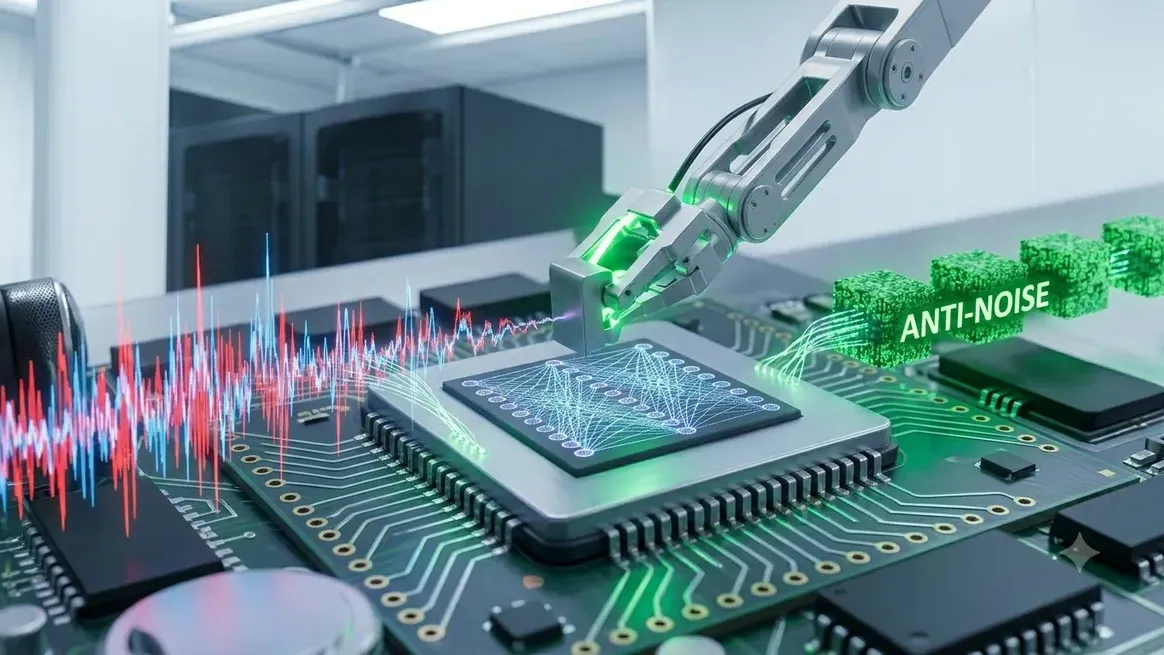
AI noise cancellation works by generating a sound wave that is the exact opposite of incoming noise, so the two cancel out. A neural network adapts that cancellation in real time to whatever you are hearing.
Active noise cancellation has been in headphones since Bose commercialized it for pilots in the 1980s, and the physics has not changed. What has changed is the intelligence layered on top, and that is what separates a 2026 pair from a 1990s headset.
The Physics: Destructive Interference
Sound is a pressure wave. Destructive interference happens when two waves of equal strength are perfectly out of phase: where one has a peak, the other has a trough. They cancel to near silence. That is the whole principle.
Active cancellation generates a phase-inverted copy of the noise, the "anti-noise," which meets the real noise at your ear and cancels most of it.
This differs from passive isolation, which uses physical material like foam and silicone tips to block sound. Passive works best on high frequencies, active on low. So premium headphones use both: passive for mids and highs, active for the low rumble passive cannot block.
Feedforward, Feedback and Hybrid ANC
There are three ways to build active cancellation, and the difference explains a lot of the gap between good and great headphones.
Feedforward ANC puts a mic on the outside of the ear cup, catching noise before it reaches your ear, inverting it, and playing the anti-noise in a fraction of a millisecond so the two arrive together. It is great for steady noise like an aircraft cabin, but struggles with sudden sounds, since by the time they are cancelled some has already passed.
Feedback ANC puts the mic inside the ear cup, measuring what you actually hear and correcting the anti-noise to match. It cleans up residual noise feedforward misses, but can oscillate if not carefully tuned, so it demands precise engineering.
Hybrid ANC, used in premium headphones, combines both: the outer mic does the predictive heavy lifting, the inner mic corrects the leftovers. Together they beat either approach alone.
Where Does the AI Come In?
Classical ANC uses fixed filters that engineers tune for typical use, then burn into the chip. They work well for the situations they were designed for, less well for others.
AI replaces or augments those fixed filters with neural networks that adapt to what you are hearing right now. Four concrete things it adds:
Adaptive filters. Instead of one fixed setting, an AI trained on many noise types recognizes your environment, steady jet engine versus chaotic coffee shop, and blends the filter behavior that suits it.
Noise classification. Sony's Adaptive Sound Control runs a classifier that reads the sound and your motion sensors to tell whether you are in a quiet office, on a busy street, or on a train, then adjusts cancellation and transparency to match, a neural network running on the headphone itself every few seconds.
Wind noise reduction. Wind hitting a microphone looks like loud noise to classical ANC, which then produces ugly artifacts trying to cancel it. An AI trained on wind can tell turbulence from real sound and back off in those bands, avoiding the artifacts.
Voice in transparency mode. Naive transparency amplifies everything, including noise. AI separates speech from background so it can lift voices while suppressing noise, for a cleaner pass-through.
What Chips Do This Work?
A premium pair like the Sony WH-1000XM6 splits the job across two chips.
A dedicated noise-cancelling chip handles the core feedforward and feedback processing with latency under 2 milliseconds, running constantly whenever ANC is on.
A second audio processor handles everything else: Bluetooth, codecs, equalization, environment classification and higher-level AI, using a mix of DSP and small neural networks.
Splitting the work is deliberate: the cancellation chip must be fast enough for sub-2ms timing, while the other handles smarter but less time-critical tasks. Purpose-built chips for each are more efficient in speed and battery than one chip doing both.
Why Does ANC Latency Matter So Much?
The timing here is among the strictest in consumer electronics: mic-to-speaker processing must finish in under 2 milliseconds.
Noise reaches your eardrum almost instantly, so if the anti-noise arrives even slightly late, it no longer cancels. It just adds a different, often worse, sound.
Hitting that window means no operating-system overhead and no scheduling delays. The chip runs bare-metal firmware with guaranteed timing in a tight loop. This is a textbook case of why some AI must run on the device itself: no cloud round-trip could ever be fast enough, the same reason AR glasses and other real-time gadgets process locally.
Is the "AI" in AI Noise Cancellation Real?
Worth answering honestly, because "AI" is thrown around loosely in headphone marketing. The core cancellation in every headphone, even AI-branded ones, is still classical DSP: digital filters and phase inversion, math that predates neural networks by decades. The AI is not doing the physics.
What AI genuinely adds is the intelligence around it: environment classification, wind detection, voice isolation, wear detection and speak-to-chat. The improvement is real but incremental.
You notice it most in transitions, walking from a quiet office into a windy street, where AI adapts in a second or two while a fixed-filter system applies the same setting regardless.
Conclusion:
AI noise cancellation is best understood as two layers. The core is unchanged physics: cancelling noise with an inverted wave through fast, dedicated DSP. On top sits a smart AI layer that reads your environment and adapts.
The AI will not silence a room that classical ANC could not, but it makes the experience noticeably better across the messy, changing real world, exactly where old fixed-filter headphones fell short. That, plus the sub-2ms latency, is why this is one of the clearest examples of AI that has to run right there on the device.
(FAQs):
Q1: Why does ANC cause a pressure sensation in your ears?
A: The anti-noise signal itself can cause it. Your brain reads very low-frequency pressure changes as a physical feeling rather than sound, and imperfect cancellation leaves a residual signal there. Many headphones now include a setting to reduce it.
Q2: Is ANC better on over-ear or in-ear headphones?
A: Both can be excellent. Over-ear models have room for larger drivers and deeper low-frequency cancellation, while well-sealed in-ears get strong passive isolation and a short anti-noise path. Top examples of each are comparable overall.
Q3: Why doesn't ANC block voices?
A: ANC weakens at higher frequencies because the wavelengths get short and the timing to cancel them gets much harder. Most systems work well below about 1 to 2 kHz, covering engine and HVAC rumble but not the range of speech.
Q4: What is Speak-to-Chat and how does it detect speech?
A: It pauses your music and switches to transparency when you talk. A small classifier tells your own voice, sensed partly through bone conduction, from external speech, kicking in within a second and switching back a few seconds after you stop.
Based on published manufacturer documentation, signal-processing literature, and independent audio testing as of 2026.