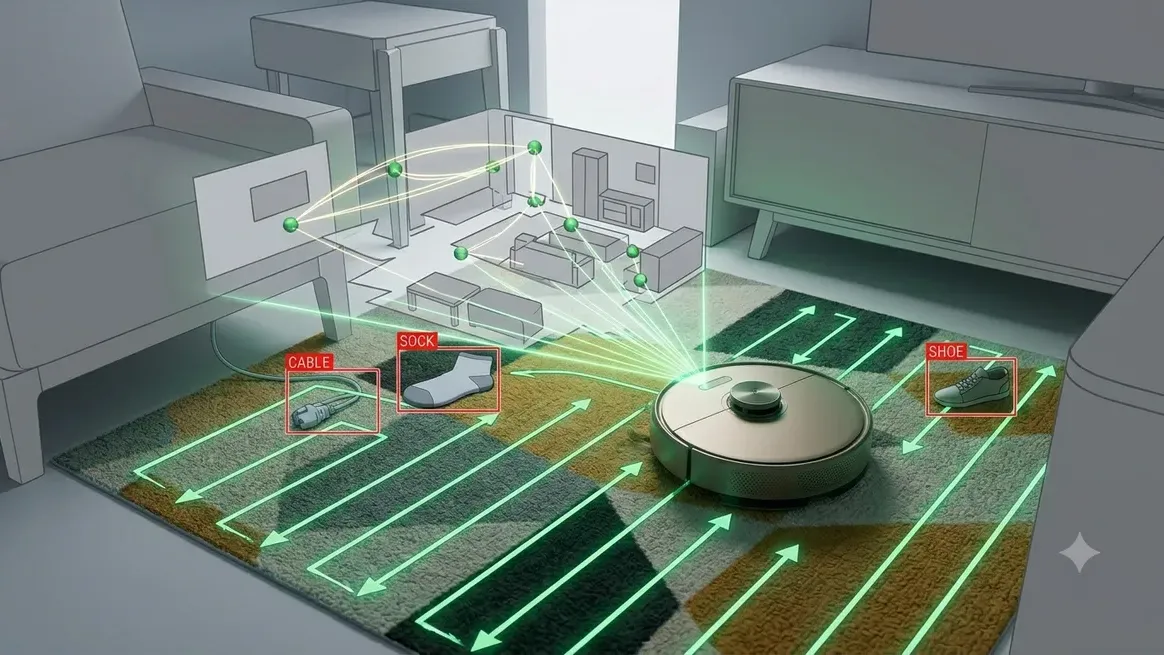
Robot vacuums navigate using SLAM, an algorithm that builds a map of your home while tracking the robot's own position in it, fed by a spinning LiDAR sensor and an AI camera that recognizes obstacles like cables and shoes. That combination is the entire difference between a cheap vacuum that bumps around at random and a premium one that cleans every room in tidy rows while dodging your charger cable and your cat. Here is how each piece works, and what actually separates a $200 model from a $999 one.
Why Doesn't a Robot Vacuum Know Where It Is?
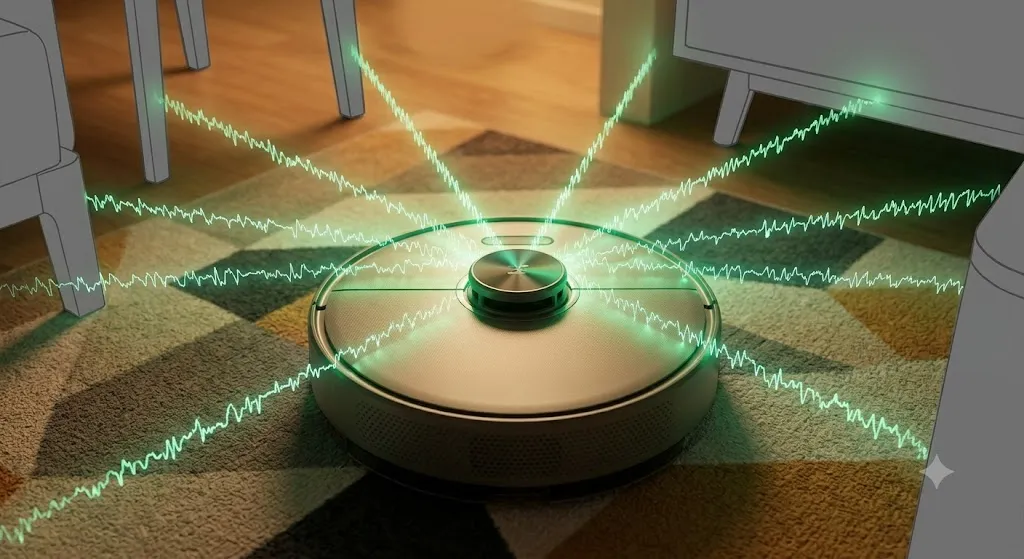
When a robot vacuum starts, it faces a real robotics problem: it has to clean an area it has not seen recently, since furniture moves, while tracking where it is and where it still needs to go, using only sensors about 8 centimeters (3 inches) off the floor.
Knowing your own position while building a map at the same time is called Simultaneous Localization and Mapping, or SLAM. It is one of the foundational problems in mobile robotics, and solving it well is what separates a navigating vacuum from the random bump-and-turn of the earliest Roombas.
How Does LiDAR Mapping Work?
LiDAR stands for Light Detection and Ranging. It is usually a spinning sensor on top of the robot that fires laser pulses in every direction and measures how long each one takes to bounce back. Since light travels at a known speed, the return time gives the exact distance to whatever the laser hit.
Spinning 5 to 15 times a second, it produces a ring of distance readings, a detailed 2D map of the room at floor level. Consumer units are accurate to about 1 to 5 centimeters (under 2 inches) with a range of 6 to 10 meters (20 to 33 feet), plenty for any room. Newer direct time-of-flight (dToF) LiDAR measures pulse travel time without the bulky spinning turret, making 2026 robots slimmer and faster to respond than older spinning-tower designs.
LiDAR has blind spots, though. It scans one horizontal plane, so it misses objects shorter than its mounting height, and it struggles with glass and mirrors, which reflect the laser away instead of back. That is exactly why modern vacuums add a camera.
How Does SLAM Actually Work?
As the robot moves, two data streams arrive: wheel odometry, which estimates movement from wheel rotation, and continuous LiDAR scans. SLAM matches each new scan against the map it is building to work out how far the robot moved and sharpen the map.
The catch is that wheel odometry drifts. If the wheels slip, the estimated position wanders from the true one. SLAM corrects this by trusting the LiDAR: if the scans say the robot is left of where odometry claims, it adjusts. When the robot returns to a spot it already mapped, it performs loop closure, recognizing the area and using it to erase accumulated drift. Premium robots run a graph-based version that re-optimizes the whole trajectory at once for a cleaner map.
How Do Robot Vacuums Detect Obstacles?
LiDAR tells the robot that something is there. It does not say what. A cable, a shoe, a toy and a pile of pet waste all look identical to a laser, and a robot that cannot tell them apart just stops or swerves at everything.
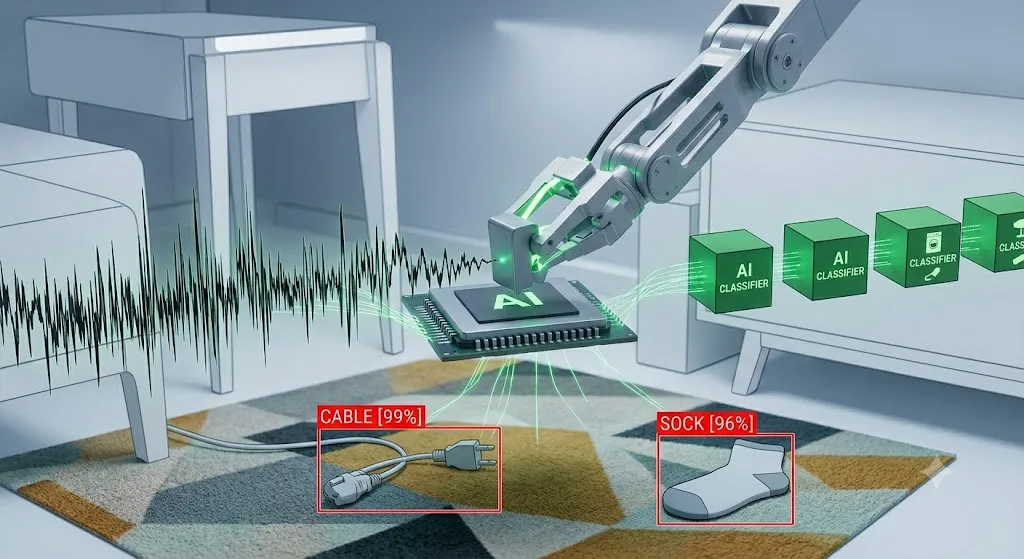
This is where computer vision comes in. A camera feeds images to a neural network trained to classify things found on floors. Roborock's system identifies over 70 categories, from charging cords and slippers to furniture legs and pet waste, and treats each differently: skirt a cable carefully, but stop and route around pet waste entirely.
The model has to run on a small chip at 15 to 30 frames a second in poor floor-level light, so vacuums use lightweight, compressed vision models. Many use a two-stage trick: a cheap classifier first checks whether any obstacle is present, and only then does a heavier one identify what it is, keeping average compute cost low.
How Do They Plan an Efficient Path?
With a map and obstacle detection in place, the robot still has to choose a route. Early vacuums moved randomly. Modern ones use coverage path planning, usually a boustrophedon pattern: the robot drives in parallel lanes across each room, like a lawn mower, so it touches every point. When it meets an obstacle mid-lane, it detours around it and returns to the row rather than abandoning it.
What Separates Premium From Budget Navigation?
The gap comes down to a few choices. LiDAR versus gyroscope-only: budget models often skip LiDAR for gyroscopes, giving rougher maps and patchier coverage. Camera and model quality: a low-resolution camera with a simple classifier misses more obstacles. Processing power: premium robots use separate chips for SLAM and vision so both run at full quality at once. Training data: a brand that has deployed millions of robots has far more floor images to train on, a compounding edge for Roborock and iRobot.
Conclusion:
A robot vacuum navigates by layering four systems: LiDAR builds the map, SLAM keeps the robot located within it, computer vision identifies what is in the way, and path planning covers the floor efficiently. None of these is magic, they are practical solutions to a hard robotics problem, squeezed onto a small chip that has to last a full cleaning session. The more of these a robot runs well, and at once, the more it feels genuinely intelligent rather than just busy.
(FAQs):
Q1: Why does my robot vacuum sometimes get lost?
A: It happens when the robot cannot match its sensor readings to its stored map. Common causes are furniture that moved since mapping, featureless walls that look identical from many angles, reflective surfaces confusing the LiDAR, or drift it cannot self-correct.
Q2: Is LiDAR or camera navigation better?
A: They solve different problems, which is why the best robots use both. LiDAR maps distances accurately and works in the dark but cannot identify objects. Cameras recognize what an obstacle is but need light. Together they cover each other's blind spots.
Q3: What is 3D obstacle avoidance?
A: Standard avoidance uses a single camera for a 2D view of the path. 3D avoidance adds structured light or stereo cameras to build a depth map, letting the robot judge an obstacle's height and shape, so it can decide whether to pass under something or go around it.
Q4: How does a robot vacuum know when a room is clean?
A: In coverage mode, a room is done when the robot has traversed every point in its planned pattern. It tracks which lanes are complete and which were skipped for obstacles. Models with dirt detection may run extra passes over high-debris areas until the sensor reads them as clean.
Technical details draw on published SLAM and mobile-robotics literature, manufacturer documentation from Roborock and iRobot, and sensor specifications. Robot vacuum navigation advances with each product generation.