
A smart ring is a small, battery-powered ring that reads your body's signals and sends them to an app on your phone. It has no screen and no buttons. You just wear it, and it quietly tracks things like your heart rate, sleep, and temperature while you go about your day.
It has become one of the fastest-growing wearables in 2026. Here is exactly what is inside one, how it works, and whether you actually need one.
What Does a Smart Ring Track?
A smart ring is built for one main job: health tracking, not notifications. You will not get text previews. You will not take calls. You will not control your music from it.
Instead, it constantly collects data from the skin on your finger. It sends that data over Bluetooth to an app on your phone. Over time, the app turns raw numbers into simple daily scores you can actually read, like a Readiness Score or a Sleep Score.
The real value is not one single reading. It is the trend over weeks and months. How well did you recover from yesterday's workout? What is your normal resting heart rate? How much deep sleep did you get last night, compared to your average?
What Sensors Are Inside It?
A tiny band packs in more hardware than you would guess. Most smart rings use a mix of these:
Optical heart rate sensors. Small LED lights shine into your finger and measure how the light bounces back. This gives your heart rate and heart rate variability, or HRV. Skin temperature sensors. These pick up small shifts in your body temperature overnight, which can hint at illness, stress, or your menstrual cycle. Accelerometers. These sense movement, so the ring knows if you are walking, running, or lying still asleep.
Some newer rings go further. Oura's current ring shifts between 18 different sensor paths, so it can still get an accurate reading no matter how the ring spins on your finger overnight.
Why the Finger Beats the Wrist:
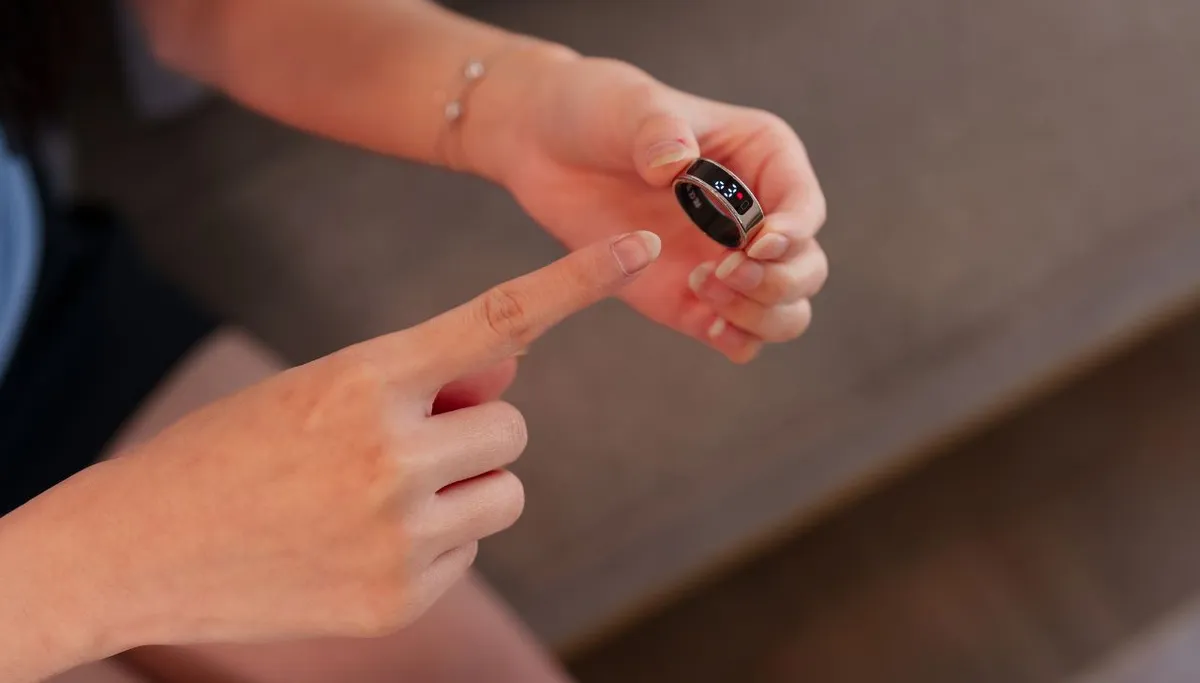
It turns out the wrist, while convenient, is not the best place for a light-based sensor. Your finger has blood vessels much closer to the skin's surface. That gives a smart ring a cleaner, steadier signal than a watch on your wrist, especially while you sleep and barely move.
This is part of why sleep tracking on a ring tends to be more consistent than on a watch. Steady skin contact matters a lot for accurate readings.
What a Smart Ring Cannot Do:
Most smart rings have no GPS. If you want a mapped running route or exact distance, you still need your phone or a dedicated watch nearby. A ring also has no screen, so you cannot check a live reading on the ring itself. You always need to open the app.
Battery life is a real strength here, though. Most rings run for 4 to 7 days per charge, far longer than a smartwatch, since there is no screen draining the battery.
Do You Need a Subscription?
This depends entirely on which ring you pick, and it is worth knowing before you choose.
Oura requires a monthly membership, around $5.99 a month, to unlock full sleep staging and Readiness scores. Samsung Galaxy Ring costs $399 once, with no subscription at all. RingConn and Ultrahuman Ring Air are also built as subscription-free alternatives, a popular choice for anyone who wants to avoid a recurring fee.
How Do You Set It Up?
Setup is simple across most brands. Install the app, like Oura, Samsung Health, or RingConn. Turn on Bluetooth, bring the charged ring close to your phone, and tap pair. Most sensors work on any finger, though some brands suggest the index finger for the best temperature readings.
The ring only collects data while it is touching your skin, so a loose fit will hurt accuracy. After about two nights of sleep, the app has enough data to show your first real Readiness Score and sleep breakdown.
Conclusion:
A smart ring is a quiet, screen-free way to track your body around the clock. It trades notifications and GPS for comfort, long battery life, and a steadier read on your heart, sleep, and temperature than a watch usually gives. Whether it is worth buying comes down to one thing: do you want a subscription-free ring like Galaxy Ring or RingConn, or the deeper insights and monthly fee that come with Oura. Either way, the value shows up over weeks, not on day one.
(FAQs):
Q1: Is a smart ring as accurate as a smartwatch?
A: For sleep and resting heart rate, yes, often more so, since a ring stays snug on the finger while a watch can shift on the wrist during the night. For live workout stats and GPS, a watch still wins.
Q2: Which smart ring has no subscription fee?
A: Samsung Galaxy Ring, RingConn, and Ultrahuman Ring Air are all built to work fully with a one-time purchase. Oura is the main exception, requiring a monthly membership for full insights.
Q3: Can a smart ring track my workouts with GPS?
A: No, but it does not need to. Keep your phone in your pocket while you run and most ring apps will pull the GPS route straight from your phone's location, so you still get a mapped run without a separate watch.
Q4: How long does a smart ring battery last?
A: It varies a bit by brand and how much continuous heart-rate tracking you leave on. A full recharge from empty usually takes under an hour, so even on a low-battery day, a short charge gets you through the night.