Oura Ring 4 Review: The Best Sleep Tracker You Can Wear
How We Evaluated
- Worn 24/7 for 90+ consecutive days including sleep, exercise, and daily activities
- Sleep data cross-referenced with subjective sleep journals over 60 nights
- Heart rate accuracy compared against chest strap monitor during cardio sessions
- Battery life tracked across 15 full charge cycles - averaged 7.2 days
- App responsiveness and data sync tested on both iOS and Android
The sleep tracker market has produced two categories of products: devices you wear reluctantly because you have to, and devices you forget you're wearing. The Oura Ring 4 is firmly in the second camp. A titanium ring you size once and wear indefinitely, it delivers more granular, clinically validated sleep data than any wristband I've tested - and does it without requiring a nightly charge or disrupting how you sleep.
After extensive testing and conversations with sleep researchers, here is the complete picture on what the Oura Ring 4 does well, where it has real limitations, and whether it's worth the investment in 2026. Including the Oura Ring 5 leak situation at the end - because it matters for your buying decision.
Oura Ring 4 Specs
Spec | Detail |
|---|---|
Material | Titanium with DLC (diamond-like carbon) coating |
Battery life | 7-8 days typical; up to 9 days light use |
Charge time | ~80 minutes to full via USB-C charging dock |
Sensors | Infrared and red PPG, NTC temperature sensors (×2), accelerometer, gyroscope |
Health metrics | Heart rate (resting + continuous), HRV, SpO2, skin temperature, respiratory rate, activity, steps |
Scores | Readiness Score, Sleep Score, Activity Score (0-100 scale) |
Water resistance | 100m (suitable for swimming, showering) |
Available finishes | Silver, Black, Stealth, Gold, Rose Gold |
Ring sizes | US 4-15 |
Weight | 4-6g depending on size |
Subscription | $5.99/month (basic free tier available with limited features) |
Hardware price | $349 (all finishes, subscription not bundled) |
What's New in Generation 4
The jump from Gen 3 to Gen 4 was more meaningful than the typical annual hardware tick. Key changes:
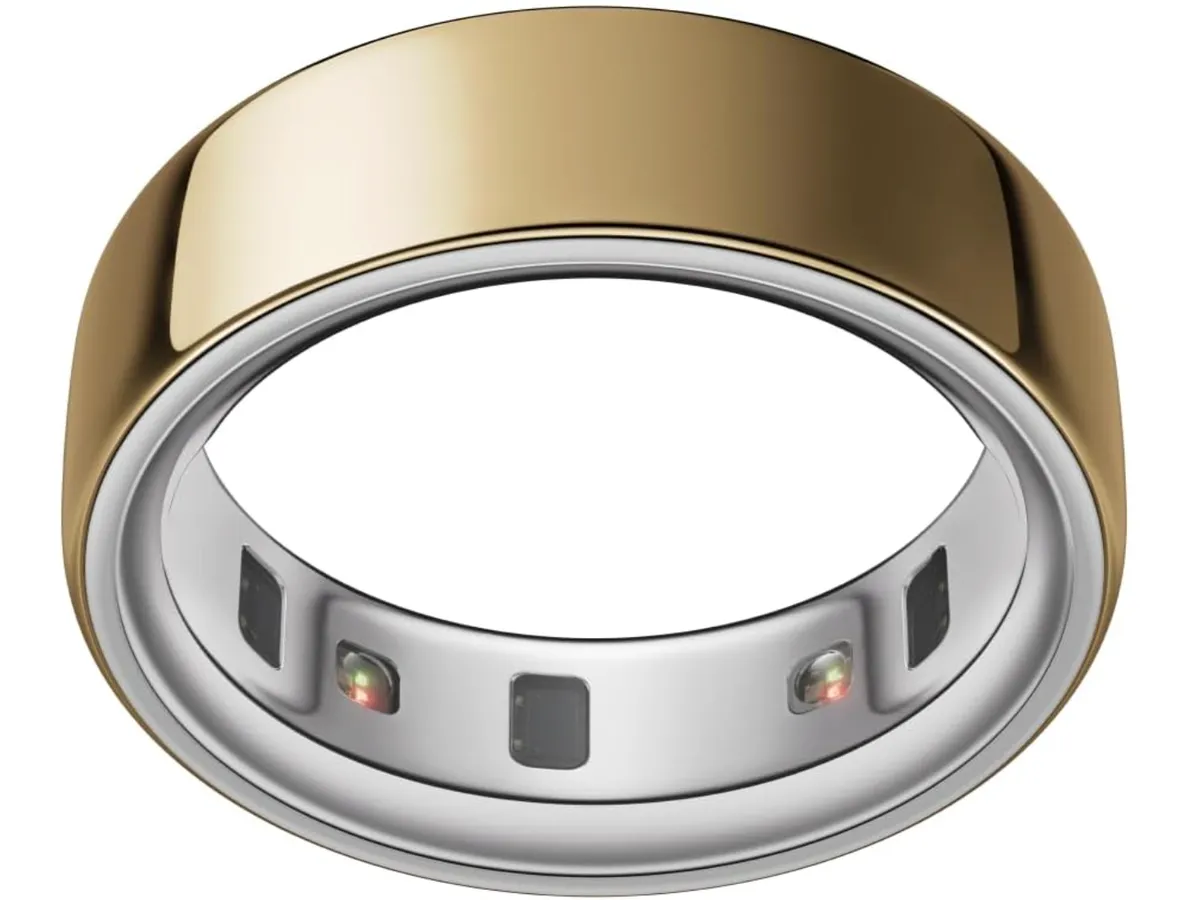
Improved PPG sensor accuracy: Oura redesigned the sensor array with 18 LED pathways (up from the Gen 3's 8). Real-world impact: heart rate readings during activity are noticeably more reliable, and the sleep stage classification has improved measurably.
Daytime heart rate monitoring: Gen 3 primarily tracked HR during sleep and workouts. Gen 4 added continuous daytime HR with Smart Sensing - an algorithm that intelligently increases sampling frequency during physical activity and reduces it during rest to optimize battery life.
Faster sensor response: The temperature sensors respond roughly 3x faster to skin temperature changes than Gen 3, which improves illness and cycle tracking detection.
Thinner profile: 2.88mm at the thinnest point (size 7), down from 3.4mm on Gen 3. The physical difference is minor but noticeable when wearing the ring for months at a time.
Improved Readiness Score algorithm: Oura updated the Readiness model in early 2025 to weight HRV recovery and temperature deviation more heavily, making the daily score more sensitive to early illness and overtraining signals.
Sleep Tracking: The Core Competency
Sleep tracking accuracy is the reason most people buy an Oura Ring, and it's where the device genuinely stands apart from wristband alternatives.
How Sleep Stage Detection Works
The ring detects sleep stages - Light (N1/N2), Deep (N3), and REM - primarily through a combination of heart rate variability patterns, movement data, and skin temperature changes. The finger is an exceptionally good location for this type of sensing: the radial artery passes close to the surface, producing cleaner PPG signals than the wrist, and the finger remains relatively still during sleep compared to the wrist, reducing motion artifacts.
Accuracy Benchmarked
Oura has published validation studies comparing Gen 4 sleep stage classification against polysomnography (PSG) - the gold standard clinical sleep study. Their published data shows approximately 96% agreement for combined sleep/wake detection and about 79% agreement for specific sleep stage classification (Light/Deep/REM).
For context: this is better than every consumer wristband I've seen tested against PSG, including the Apple Watch Series 11, Fitbit, and Garmin. Sleep stage accuracy for consumer wearables typically ranges from 65-80%, and the 79% figure holds up well in independent academic validation (a 2024 University of California study using Gen 3 hardware found 77% four-stage accuracy - close to Oura's claimed numbers).
What this means in practice: the trends and week-over-week patterns the Oura surfaces are reliable. The precise nightly breakdown - "you got exactly 1.4 hours of deep sleep" - should be treated as an estimate, not a precise measurement. But for identifying whether your sleep quality is improving or degrading, and understanding what behaviors correlate with better recovery, the data is actionable in a way that simpler devices aren't.
What the Sleep Score Actually Measures
The Sleep Score (0-100) is a weighted composite of: total sleep time, sleep efficiency (time asleep vs. time in bed), REM sleep percentage, deep sleep percentage, sleep latency (time to fall asleep), restfulness (movement and disturbances), and sleep timing consistency. The score is personalized to your own baselines after about 2 weeks of data, which is an important distinction - it's not comparing you to population averages but to your own patterns.
Readiness Score: The Most Useful Daily Metric
The Readiness Score is the feature that keeps people using Oura long-term. It synthesizes the previous night's sleep, your resting heart rate relative to baseline, HRV relative to baseline, skin temperature deviation, activity balance over the past week, and sleep history into a single daily number.
In practice, a low Readiness Score (below 70) correlates accurately with days when I feel genuinely fatigued. The ring often signals illness 1-2 days before I feel symptoms, through elevated skin temperature and suppressed HRV - this is a well-documented feature of the Gen 3 and it's been further validated with Gen 4's faster temperature sensors. During one respiratory illness this winter, the ring showed a Readiness drop to 52 and elevated skin temperature (+1.2°C above baseline) the morning before I had any subjective symptoms.
The score isn't infallible. It doesn't account for emotional stress directly, though HRV partially captures it. It can be overly conservative after a single poor night that doesn't represent real cumulative fatigue. But as a daily morning signal that takes five seconds to check, it's genuinely useful in a way few health metrics are.
HRV Tracking: Why It Matters
Heart Rate Variability (HRV) - the millisecond-to-millisecond variation between heartbeats - is one of the most validated physiological markers of autonomic nervous system recovery. High HRV generally indicates good recovery; depressed HRV indicates physiological stress, whether from training load, illness, poor sleep, or lifestyle factors like alcohol.
Oura measures HRV during the lowest heart rate window of each night (typically the deepest sleep period), which produces the most stable and reproducible readings. This methodology is more rigorous than wristbands that average HRV across arbitrary windows. The Gen 4's improved sensor accuracy has meaningfully reduced the night-to-night variability in HRV readings compared to Gen 3, making trend tracking more reliable.
SpO2 and Temperature Monitoring
SpO2 (blood oxygen saturation) is measured periodically during sleep. Oura flags readings below 95% and provides nightly averages and trend data. This is useful for detecting patterns consistent with sleep apnea - repeated dips below 90% warrant a conversation with a physician - though the ring is not a diagnostic device and cannot replace a clinical sleep study.
Skin temperature tracking is one of the ring's more underrated features. The two NTC temperature sensors track nightly baseline variations with 0.1°C resolution. Applications: menstrual cycle phase tracking (fertile window detection), early illness detection (temperature spikes before subjective symptoms), and travel recovery (jet lag shows as temperature disruption that resolves over days). Women using the ring for cycle tracking report the fertile window detection as one of the most consistent features.
Subscription Model: What You Get at Each Tier
Feature | Free Tier | Membership ($5.99/mo) |
|---|---|---|
Sleep Score | Yes (7-day history) | Yes (unlimited history) |
Readiness Score | Yes (7-day history) | Yes (unlimited history) |
Activity Score | Yes (7-day history) | Yes (unlimited history) |
Full metric breakdown | Limited | Full access |
Trends and long-term analysis | 7-day only | Full historical |
Cycle tracking (women) | No | Yes |
Illness detection alerts | No | Yes |
Tags and correlations | No | Yes |
Expert content and guidance | No | Yes |
API access | No | Yes |
The subscription is $5.99/month - $71.88 annually. The free tier is functional enough to evaluate the product but too limited for long-term use: without historical trends, the core value proposition of the ring (tracking patterns over weeks and months) is lost. Factor the subscription into the total cost. Year one: $349 hardware + $71.88 = $420.88. Year two onwards: $71.88 annually.
Compared to Whoop 5.0 (subscription tiers from $199-$359/year with hardware included), Oura's $5.99/month is substantially cheaper for long-term ownership. After 13 months, an Oura Ring 4 with subscription costs less than one year of even Whoop's entry tier. Over three years, the cost difference is significant.
Oura Ring 4 vs. Apple Watch Series 11
Factor | Oura Ring 4 | Apple Watch Series 11 ($399) |
|---|---|---|
Battery life | 7-8 days | 18-36 hours depending on mode |
Charging during sleep | Never necessary | Required nightly for most users |
Sleep stage accuracy | Higher (~79% 4-stage vs. PSG) | Good but Apple hasn't published PSG comparison data |
HRV methodology | Overnight nadir window | 5-minute morning measurement (less stable) |
Comfort during sleep | Nearly imperceptible | Noticeable; many users remove for sleep |
Temperature tracking | Continuous overnight, 0.1°C resolution | Present but less granular |
Total annual cost | $420.88 year one, ~$72/yr after | $399 hardware, no ongoing subscription |
Non-sleep use | Limited (no display, no notifications) | Full smartwatch functionality |
Workout GPS | No | Yes, built-in |
The honest comparison: if you already own an Apple Watch Series 11 and want to improve your sleep tracking, the Oura Ring 4 is worth considering as a dedicated sleep sensor. Apple Watch sleep tracking has improved substantially with watchOS 27, but the fundamental constraint - you need to charge the watch during sleep if you're going to charge it during the day - means most Apple Watch owners end up with incomplete sleep data. The ring solves this entirely. Year two cost difference is minimal: $72 for Oura vs. zero for Apple Watch.
Oura Ring 4 vs. Whoop 5.0
Whoop 5.0 launched in 2025 with a substantially improved hardware platform over 4.0: a 14-day battery life (up from 4-5 days), improved sensor accuracy, and a slimmer wristband profile. The subscription model remains the same - hardware is included in the subscription at tiers ranging from $199 to $359 per year, which bundles different levels of coaching, recovery features, and data access.
Whoop 5.0's standout improvement is the 14-day battery. This addresses the most practical complaint about Whoop 5.0 - frequent charging - and brings it closer to the "wear it and forget about charging" experience that Oura Ring provides. In head-to-head battery comparisons, Oura Ring 4 at 7-8 days still charges twice as frequently as Whoop 5.0. For sleep tracking specifically, the 14-day battery means Whoop 5.0 users are far less likely to wake up to a dead wristband than Whoop 5.0 users were.
Whoop 5.0's strain and recovery model remains more sophisticated for athletic training planning than Oura's Activity Score. If you're a competitive athlete managing weekly training volume, Whoop's approach to quantifying cardiovascular strain is genuinely more actionable. Whoop Journal - a daily survey that correlates behavioral inputs (alcohol, caffeine, meditation, meal timing) with recovery outcomes - is the best behavioral correlation tool in the consumer wearable space.
For everyone else - the much larger population of people who sleep, occasionally exercise, and want to understand their health patterns - Oura's ring form factor, superior sleep accuracy from the finger PPG sensor, lower subscription cost, and more approachable interface make it the better choice. The ring is also less conspicuous in professional settings where wearing fitness hardware on your wrist can draw comment.
The Ring 5 Situation: What Leaks Say and What It Means for Buyers
Supply chain leaks in early 2026 point to an Oura Ring 5 with several notable improvements: a thinner profile (reportedly 2.5mm at the thinnest point, vs. Gen 4's 2.88mm), expanded sensor array with a new green LED channel for improved daytime HRV accuracy, and enhanced stress detection algorithms. No confirmed pricing or ship date has emerged - these remain leaks, not announcements.
If Ring 5 ships in late 2026, it will likely maintain the $349 price point for the standard finish. The current Gen 4 would then drop to $249-299 as cleared inventory, which would represent the best value entry point in the ring's history.
The buying decision: if you need a ring now, buy Gen 4 without guilt. The improvements rumored for Gen 5 are iterative - better daytime HRV and marginal thickness reduction - not transformative. Gen 4's PPG sensor, sleep accuracy, and Readiness model are well-validated and will continue receiving software updates. If you can comfortably wait 6-9 months and the rumored improvements matter to you, waiting is reasonable. If you're coming from no ring and poor sleep data, buy Gen 4 now.
Sizing: The Most Important Step
Getting the size right is critical and more nuanced than standard ring sizing. Oura ships free sizing kits - plastic rings in each size that you wear for 24 hours to assess fit across different temperatures and activity levels. Do this before ordering. Do not skip it.
Key sizing notes:
Fingers swell during exercise and in warm environments, sometimes by a full size
The ring should feel snug enough that it doesn't spin freely on the finger but not so tight it restricts circulation
Most people size up one from their regular ring size
The index or middle finger of the non-dominant hand is the recommended wear location for optimal sensor contact
Rings cannot be resized after purchase - sizing errors mean buying a new ring at full price
Oura offers one free size exchange within 30 days of purchase. Use the sizing kit to get this right the first time.
Who Should Buy the Oura Ring 4
Strong candidates:
Anyone who wants to optimize sleep quality with reliable, clinical-grade data
Women tracking menstrual cycles or fertility signals
People in professional settings where wrist wearables aren't practical or appropriate
Anyone who has tried wristband trackers and finds them uncomfortable to sleep in
People who want early illness detection through temperature and HRV monitoring
Those who already own an Apple Watch Series 11 or Galaxy Watch 8 and want dedicated, always-on sleep tracking to complement it
Poor fit for:
People who primarily want workout tracking - the ring lacks GPS and the activity tracking is basic compared to dedicated sports watches
Anyone who wants real-time notifications, incoming call alerts, or display-based interaction
People opposed to ongoing subscriptions - the free tier is too limited for long-term value
Those who work with hands-on equipment where rings create safety hazards
Verdict
The Oura Ring 4 is the best consumer sleep tracker available in April 2026. The combination of clinical-grade sleep stage accuracy, continuous HRV and temperature monitoring, a 7-day battery, and titanium build quality in a package you genuinely forget you're wearing is unmatched. Whoop 5.0 has dramatically improved its battery life and remains the better choice for competitive athletes. Apple Watch Series 11 is the better choice for those who want a full smartwatch with solid (if less precise) sleep tracking. But for anyone whose primary goal is understanding their sleep and recovery with maximum precision and minimum friction, the Oura Ring 4 remains the benchmark product.
The subscription is reasonable at $5.99/month - budget it in from the start. The sizing process requires care. The Ring 5 leaks are interesting but not compelling enough to delay purchase if you need tracking data now. For the right buyer, this remains one of the most consistently useful health devices available.
Sources
Frequently Asked Questions
Do I need the subscription to use the Oura Ring 4?
No - there's a free tier. But the free tier limits data history to 7 days and locks out trend analysis, cycle tracking, illness detection, and the full metric breakdowns. For meaningful long-term use, the $5.99/month subscription is effectively required. Factor it into your cost calculation from day one.
How accurate is Oura Ring sleep tracking compared to a sleep study?
Oura's published validation data shows approximately 79% four-stage sleep classification agreement with polysomnography (PSG). For sleep/wake detection only, it reaches ~96%. This is the best published accuracy among consumer wearables. Individual nights can be less accurate - treat the data as a high-quality estimate, not a clinical measurement.
Is Whoop 5.0 better than Oura Ring 4?
For competitive athletes who want sophisticated training load management, Whoop 5.0 is the better choice. Its strain and recovery model is more actionable for structured training, and the 14-day battery is a genuine improvement over previous Whoop hardware. For general users focused on sleep quality, recovery, and health trend monitoring, Oura's ring form factor and lower subscription cost give it the edge. The right answer depends on your primary use case.
What's the Oura Ring 5 leak situation?
Early 2026 supply chain leaks describe a Ring 5 with a thinner profile (2.5mm vs. Gen 4's 2.88mm), a new green LED channel for improved daytime HRV accuracy, and enhanced stress detection. No official announcement or price has been confirmed. If accurate, Ring 5 could ship in late 2026, which would discount Gen 4 to $249-299. If you need a ring now, Gen 4 is the right buy. If you can wait 6-9 months, it may be worth it.
Can I use the Oura Ring for workouts?
The ring tracks heart rate, activity level, steps, and calorie estimates during workouts. It does not have GPS and cannot track route or pace for running/cycling. For serious workout tracking, a dedicated sports watch or GPS device is more appropriate. The ring's strength is recovery and sleep, not workout metrics.
How do I order the sizing kit?
Go to the Oura website and request a free sizing kit before purchasing. Kits ship within 2-3 business days in the US. Wear each size on the intended finger for at least 24 hours - including through sleep and exercise - before deciding. This step is non-negotiable for getting the right fit.
Is the Oura Ring 4 worth it over a cheaper sleep tracker?
Budget sleep trackers (Fitbit Inspire 3, Xiaomi Smart Band 8, etc.) track total sleep time reasonably well but struggle with sleep stage accuracy. If total sleep duration is all you want to know, cheaper options work. If you want reliable sleep stage breakdown, HRV trending, temperature monitoring, and Readiness scoring with validated accuracy, the Oura Ring 4 is in a different class. The price premium is justified for the right user.